
TL;DR
- Algorithmic Evolution: Reinforcement Learning (RL) has transitioned from academic theory to production-grade trading infrastructure, enabling autonomous agents to learn complex execution and portfolio management strategies through trial and error.
- State-of-the-Art Algorithms: Advanced policy gradient methods like Proximal Policy Optimization (PPO) and Soft Actor-Critic (SAC) have become the industry standard for handling the noisy, continuous action spaces inherent in financial markets.
- Bridging the Reality Gap: Open-source frameworks like FinRL-X have modernized quantitative research by providing standardized benchmarks, realistic market simulators, and direct broker integration, closing the gap between paper trading and live execution.
The Fundamentals of Reinforcement Learning
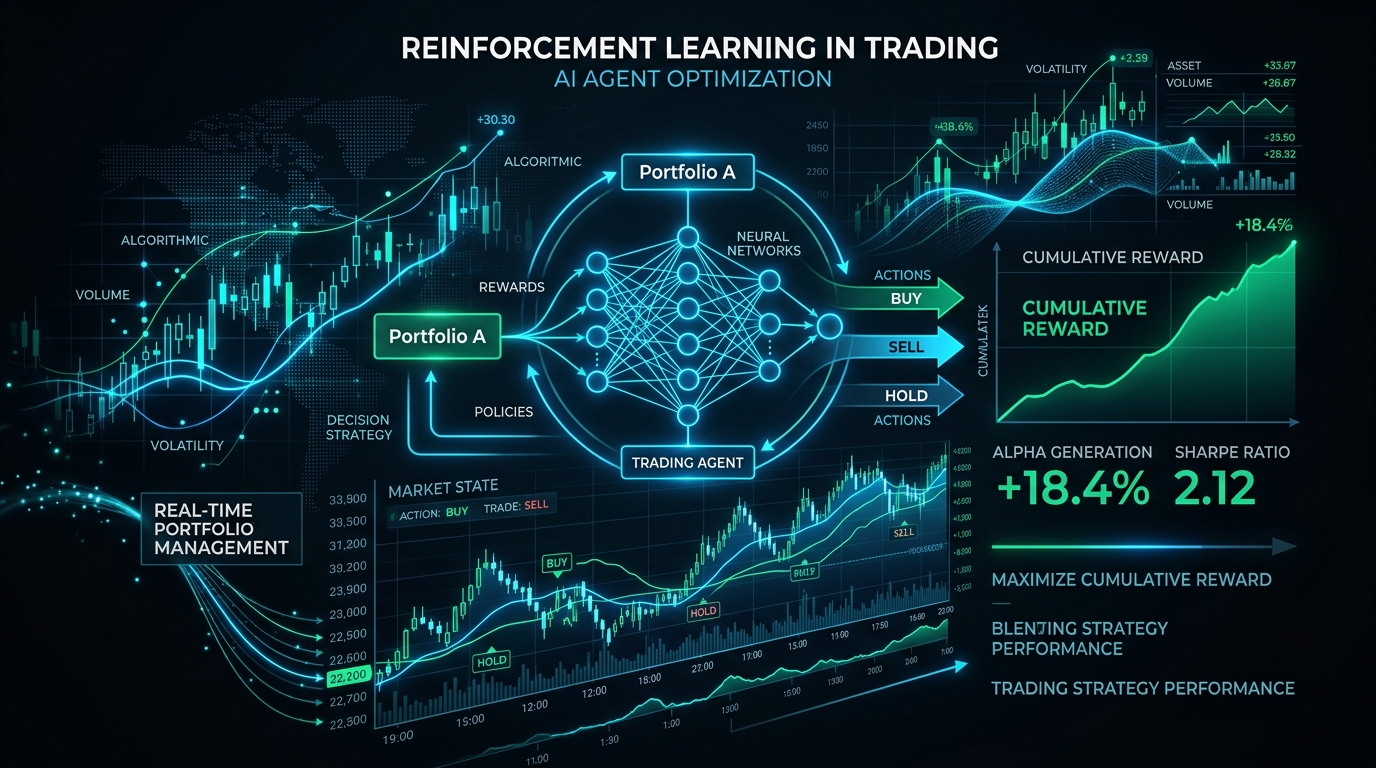
Reinforcement Learning (RL) is a paradigm of machine learning distinct from both supervised and unsupervised learning. In supervised learning, a model learns to map inputs to outputs based on a perfectly labeled dataset. In trading, this often looks like trying to predict tomorrow's closing price based on historical indicators. RL, however, takes a behavioral approach. It involves an Agent operating within an Environment (the market). The agent observes the current State (price data, order book depth, macroeconomic indicators), takes an Action (buy, sell, hold, or allocate portfolio weights), and receives a Reward (profit, risk-adjusted return, or a penalty for drawdown).
The objective of the RL agent is to learn a Policy - a mapping from states to actions - that maximizes the cumulative expected reward over time. This makes RL uniquely suited for financial markets. Trading is not merely about predicting the next price tick; it is a sequential decision-making process involving transaction costs, market impact, and risk management. An RL agent doesn't just learn to predict; it learns to survive and optimize long-term portfolio growth.
The mathematics underpinning RL in continuous spaces (like financial markets) heavily rely on deep neural networks to approximate value functions and policies, giving rise to Deep Reinforcement Learning (DRL). Frameworks like OpenAI's Spinning Up in Deep RL have standardized the educational baseline for these algorithms, providing robust implementations of Vanilla Policy Gradients and Actor-Critic architectures that quants use as foundational building blocks.
State-of-the-Art Algorithms: DQN, PPO, and SAC
The transition of RL from playing video games to executing high-frequency trades relies on sophisticated algorithms capable of handling high-dimensional, noisy data. Early applications often utilized Deep Q-Networks (DQN). DQN is a value-based method that learns the expected future reward (the Q-value) of taking a specific action in a specific state. While revolutionary, DQN struggles in environments with continuous action spaces - it works well for deciding "Buy 100 shares," but fails when the action is "Allocate 14.32% of the portfolio to Asset A."
To solve this, quantitative firms largely shifted to Policy Gradient methods, specifically Proximal Policy Optimization (PPO) and Soft Actor-Critic (SAC). PPO, popularized by OpenAI, is an actor-critic algorithm that strikes a balance between ease of tuning, sample efficiency, and stability. It uses a "clipping" mechanism to ensure the agent's policy doesn't change too drastically in a single update, preventing the catastrophic forgetting that plagues many neural networks in volatile financial environments.
SAC takes a different approach by incorporating maximum entropy RL. In SAC, the agent is rewarded not just for maximizing profit, but for acting as randomly as possible while still being profitable. This encourages aggressive exploration of the state space, preventing the agent from converging prematurely on a suboptimal, highly correlated trading strategy. In highly competitive markets, the robust exploration mechanisms of SAC often yield more resilient trading policies that survive regime shifts better than standard value-based methods.
RL Algorithm Comparison in Trading
| Algorithm | Type | Action Space | Stability | Typical Trading Use Case |
|---|---|---|---|---|
| DQN | Value-Based | Discrete | Moderate | Simple algorithmic execution (Buy/Hold/Sell) |
| A3C | Actor-Critic | Continuous/Discrete | Low (Asynchronous) | Multi-asset parallel market screening |
| PPO | Actor-Critic | Continuous/Discrete | High | Portfolio weight allocation, risk management |
| SAC | Actor-Critic (Max Entropy) | Continuous | Very High | High-frequency execution, exploring new strategies |
The Challenges of Production and the Role of FinRL
Despite the theoretical elegance of RL, deploying autonomous agents in live markets presents severe practical challenges. The most prominent is the "sim-to-real gap." An RL agent trained in a historical backtest assumes infinite liquidity, zero slippage, and immediate execution. When deployed live, its actions impact the market, causing adverse price movements. Furthermore, agents are notoriously prone to "reward hacking" - finding mathematical loopholes in the simulation (e.g., exploiting a rounding error in transaction cost calculations) rather than learning a genuine alpha-generating strategy. Overfitting to historical noise is also fatal, as financial time series possess vanishingly low signal-to-noise ratios.
To combat these issues, the quantitative finance community has rallied around robust, open-source infrastructure. The FinRL framework (detailed in numerous arXiv papers by the AI4Finance Foundation) has evolved from an educational tool into a production-grade ecosystem (FinRL-X). It provides a standardized universe of market environments, rigorous benchmarking protocols, and modular integrations with live brokers. By standardizing the environment, FinRL allows researchers to isolate the performance of the algorithm from the mechanics of data ingestion and order routing.
Elite proprietary trading firms like Hudson River Trading and market makers like Citadel Securities are known anecdotally to deploy vast compute resources toward reinforcement learning, specifically optimizing their smart order routers and high-frequency execution algorithms to minimize market impact. As compute costs decrease and simulation fidelity improves, RL is rapidly moving from the exclusive domain of ultra-high-net-worth hedge funds to broader institutional adoption. For related reading on how AI is reshaping predictive modeling, explore our guide on Transformer Models in Financial Forecasting.
Disclaimer: This article is for informational purposes only and does not constitute financial, investment, or legal advice. Algorithmic trading involves significant risk of capital loss. Consult with a qualified professional before making any investment decisions.