
TL;DR
- Financial institutions deploy synthetic data to train advanced machine learning models securely.
- Generative Adversarial Networks produce datasets that preserve statistical properties without exposing real identities.
- Hedge funds utilize synthetic environments to backtest algorithmic trading strategies without risking signal leakage.
- Strict regulatory frameworks drive the adoption of synthetic data for cross-border financial research.
The Data Privacy Dilemma in Finance
Machine learning models require vast amounts of high-quality data to achieve predictive accuracy. Financial institutions possess massive archives of transaction histories, customer profiles, and market microstructure data. Strict privacy regulations prevent data science teams from directly accessing this information for model training. Personally identifiable information restrictions severely limit the utility of raw consumer datasets. Quantitative trading firms face a different but equally restrictive challenge regarding data access.
Hedge funds tightly control their proprietary trading data to prevent strategy replication. Exposing raw order flow data to external research partners or cloud computing environments risks catastrophic intellectual property theft. Signal leakage can destroy the alpha-generating potential of a quantitative strategy in days. The industry requires a mechanism to leverage the statistical richness of internal data without exposing the underlying confidential records. Synthetic data generation emerged as the definitive solution to this systemic bottleneck.
Generative Adversarial Networks in Action
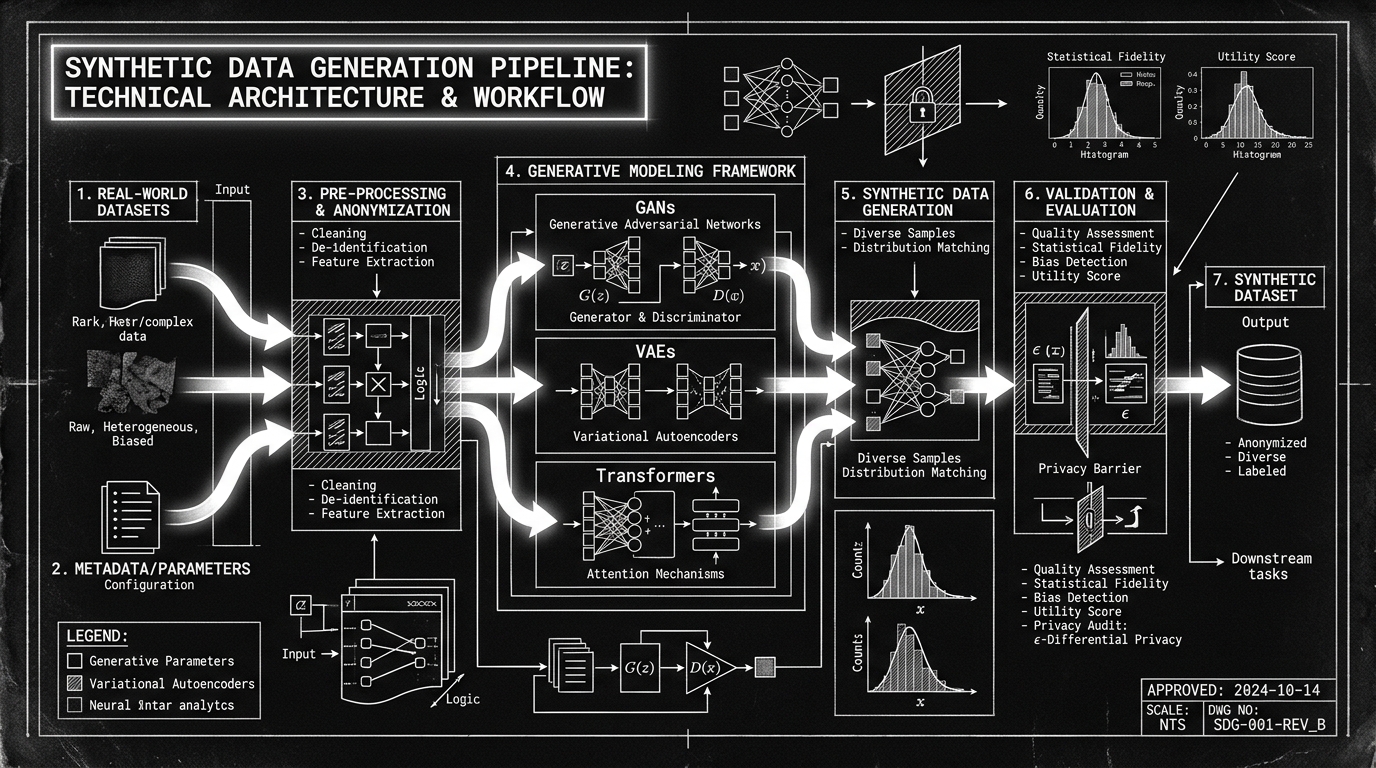
Financial engineers rely on Generative Adversarial Networks to create robust synthetic datasets. A GAN consists of two neural networks operating in opposition. The generator network attempts to create artificial data points that mimic the statistical distribution of the original dataset. Simultaneously, the discriminator network evaluates these generated points against the real data to detect fakes. This adversarial process continues until the generator produces synthetic data indistinguishable from the actual records.
Banks use GANs to synthesize millions of retail transaction records. These synthetic datasets capture complex spending patterns, seasonal variations, and correlations between merchant categories. Data science teams utilize this artificial data to train fraud detection algorithms and credit scoring models. Because the synthetic records correspond to no actual individuals, the data moves freely across international borders. Global banks share these datasets across regional research hubs without violating local data sovereignty laws.
Applications in Algorithmic Trading
Quantitative finance teams apply synthetic data to solve critical backtesting challenges. Historical market data limits the ability to test algorithms under unprecedented market conditions. Quants generate synthetic order book data simulating extreme volatility events or systemic liquidity shocks. Testing algorithms against these artificial scenarios reveals hidden vulnerabilities in automated execution logic. Funds ensure their systems remain resilient during events like flash crashes or unexpected interest rate hikes.
Hedge funds also use synthetic generation to anonymize their historical trades before sharing them with third-party quantitative researchers. The synthetic trade logs preserve the statistical footprint of the fund's execution style. External researchers develop optimization algorithms based on this synthetic data. The fund then applies the optimized logic to its real trading infrastructure. This abstraction layer protects the exact timing and sizing of the fund's historical positions.
Differential Privacy Enhancements
Advanced synthetic data pipelines incorporate differential privacy guarantees to strengthen security. Differential privacy adds calibrated mathematical noise during the data generation process. This noise ensures that an attacker cannot determine whether a specific individual's data was included in the original training set. The addition of noise creates a direct tradeoff between absolute privacy and the predictive utility of the synthetic data. Financial institutions must balance these competing priorities based on the specific use case.
For retail banking applications, maximum privacy remains the paramount concern. Institutions accept minor degradations in model performance to ensure strict regulatory compliance. In high-frequency trading environments, even microscopic deviations in statistical fidelity can render synthetic data useless. Quants tune their generation models to minimize noise while still obscuring the underlying proprietary signals. Achieving this optimal balance requires significant expertise in both cryptography and financial econometrics.
Overcoming Implementation Challenges
The transition to synthetic data training pipelines presents substantial technical hurdles. Evaluating the quality of generated data requires sophisticated statistical testing. Poorly generated synthetic data introduces bias and degrades the performance of downstream machine learning models. Financial institutions must implement rigorous validation frameworks to compare the multidimensional distributions of real and artificial datasets. If a synthetic dataset fails to capture tail-risk events accurately, models trained on it will fail catastrophically in live markets.
Compute costs also represent a significant barrier to entry. Training complex GANs on terabytes of high-frequency tick data demands massive GPU clusters. Smaller hedge funds and regional banks often lack the infrastructure budget to support continuous synthetic data generation. Cloud providers now offer specialized financial synthetic data generation platforms to address this infrastructure gap. These managed services democratize access to privacy-preserving machine learning techniques across the financial sector.
The Future of Collaborative Finance Research
Synthetic data fundamentally changes how financial institutions collaborate on research. Competing banks now pool synthetic datasets to train industry-wide models for detecting money laundering and systemic fraud. These consortiums improve the collective security of the financial system without compromising institutional confidentiality. The ability to share realistic, non-sensitive data accelerates the development of advanced AI applications across the sector.
Regulators encourage this collaborative approach to systemic risk management. Central banks analyze synthetic transaction networks to model the propagation of financial shocks. As generation techniques improve, synthetic data will become the standard medium for all financial machine learning research. Institutions mastering these pipelines will attract top AI talent by offering access to rich, unencumbered data environments.
Disclaimer: The information provided in this article is for educational and informational purposes only and does not constitute financial, investment, or trading advice. Algorithmic trading and the use of AI in finance involve significant risks. Readers should consult with a qualified financial advisor before making any investment decisions.