
TL;DR
- The Information Edge: Institutional investors are spending billions annually on alternative datasets to generate alpha before traditional financial metrics hit the market.
- Predicting Reality: By utilizing satellite imagery and anonymized credit card receipts, quantitative models can accurately predict a retailer's quarterly earnings weeks before the official announcement.
- The Compliance Minefield: The SEC is heavily scrutinizing how funds ingest this data, penalizing those who fail to screen for Material Non-Public Information (MNPI) or privacy violations.
A Taxonomy of Alternative Data
In the hyper-competitive world of quantitative finance, the traditional data edge is gone. Earnings reports, SEC filings, and standard market price feeds are ingested by algorithms globally in milliseconds, leaving little room for arbitrage. To generate sustained alpha, top-tier hedge funds have turned to "alternative data" - massive, non-traditional datasets that offer an opaque, early window into economic activity. This shift represents a fundamental evolution from financial analysis to data science, requiring advanced machine learning pipelines to extract signal from noise.
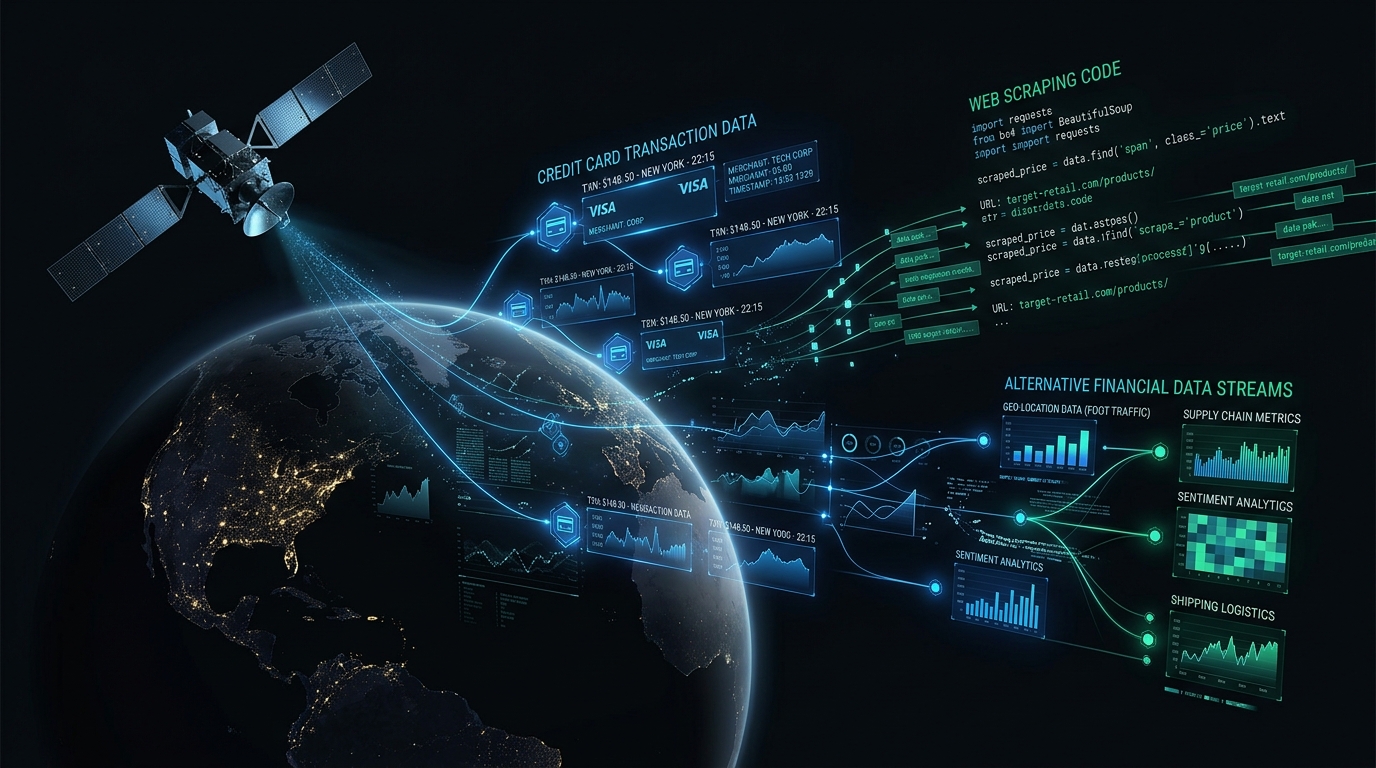
The taxonomy of alternative data is vast and continually expanding. At the foundation is Web Scraped Data, encompassing everything from job postings (indicating corporate expansion) to e-commerce pricing and product reviews. Next is Exhaust Data, the digital breadcrumbs left by consumer activity, such as anonymized credit card receipts, point-of-sale data, and app usage metrics. Finally, there is Sensor Data, which includes geolocation data from smartphones, IoT device logs, and high-resolution satellite imagery. Each category requires unique processing techniques and carries distinct latency and pricing models.
Integrating these disparate datasets is not trivial. Raw alternative data is notoriously messy, unstructured, and prone to massive gaps. Hedge funds employ armies of data engineers to clean, normalize, and map this data to specific ticker symbols. This process is heavily reliant on artificial intelligence. For instance, parsing the sentiment of thousands of localized product reviews requires sophisticated natural language models. To understand how these models process unstructured text, read our guide on NLP in Financial News: How Algorithms Read Markets.
Case Studies: Satellites and Credit Cards
The application of alternative data is best understood through real-world case studies. Perhaps the most famous example is the use of satellite imagery to monitor retail performance. By purchasing daily, high-resolution images of Walmart and Target parking lots across the United States, computer vision algorithms can count the number of cars present. When cross-referenced with historical data and adjusted for weather patterns, this data provides an incredibly accurate, real-time estimate of foot traffic and, by proxy, quarterly revenue. The funds holding this data know if a retailer is having a strong quarter weeks before the CEO steps to the podium.
Similarly, anonymized credit card transaction data has revolutionized consumer sector trading. Data brokers purchase bulk, anonymized transaction feeds from major credit card networks or personal finance apps. This data is then sold to quantitative funds who track spending down to the specific merchant category. If a fast-casual restaurant chain launches a highly anticipated new menu item, funds monitoring credit card data can see the exact spike in nationwide sales the very next day. They can track average ticket size, customer retention, and regional performance, adjusting their positions long before Wall Street analysts release their revised estimates.
The vendor landscape supplying this intelligence is booming. Marketplaces like Nasdaq Data Link and specialized aggregators like Eagle Alpha act as the connective tissue between raw data producers and Wall Street consumers. These vendors do the heavy lifting of sourcing and standardizing the data, allowing hedge funds to focus purely on signal extraction. However, as certain datasets - like basic credit card receipts - become more commoditized and widely adopted, the alpha they generate decays rapidly, forcing funds to constantly hunt for more obscure, proprietary data sources.
Navigating the Regulatory Minefield (MNPI)
While the profit potential is massive, the ingestion of alternative data presents a severe regulatory risk. The U.S. Securities and Exchange Commission (SEC) has made it clear that existing securities laws apply strictly to these novel information sources. The primary danger is the inadvertent acquisition of Material Non-Public Information (MNPI). If an alternative data vendor accidentally includes identifiable corporate data or insider metrics that are not publicly available, any fund trading on that information could be guilty of insider trading, regardless of whether the acquisition was intentional.
This has forced hedge funds to build robust, specialized compliance frameworks. Before a new alternative dataset is approved for trading, it must undergo rigorous legal due diligence. Compliance officers investigate how the vendor sources the data, ensuring it complies with privacy regulations like the GDPR in Europe and the CCPA in California. They must verify that web scraping activities do not violate terms of service or cross into computer fraud. The SEC's landmark enforcement action against the alternative data provider App Annie in 2021 served as a stark warning to the industry: relying on a vendor's assurances is not a substitute for independent verification.
Furthermore, funds must establish "ethical walls" and quarantine procedures for untested data. If a dataset is flagged as potentially containing MNPI, the compliance team must immediately halt its ingestion and isolate any algorithms exposed to it. As the alternative data industry matures, the ability to safely and legally ingest massive datasets has become just as critical a competitive advantage as the data science itself. Funds that can efficiently navigate this regulatory minefield are the ones poised to maintain their edge in the markets of tomorrow.
Alternative Data Categories at a Glance
| Category | Typical Sources | Data Lag Time | Relative Cost | Primary Use Case |
|---|---|---|---|---|
| Consumer Transactions | Credit cards, POS systems, email receipts | T+1 to T+5 days | Very High | Predicting retail/e-commerce quarterly revenue. |
| Web Data / Scraping | Job boards, app store rankings, public forums | Real-time / Intraday | Low to Medium | Tracking corporate expansion, product demand, brand sentiment. |
| Geolocation / Footfall | Smartphone GPS, connected cars | T+1 to T+3 days | High | Monitoring physical store traffic, supply chain logistics. |
| Satellite & Sensor | Commercial satellites, weather sensors, maritime AIS | Real-time to T+2 days | High | Estimating crop yields, oil reserves, shipping volumes. |
Disclaimer: This article is for informational purposes only and does not constitute financial, legal, or investment advice. Always consult with a qualified professional before making investment decisions.