
TL;DR
- Quantitative Edge: The SG CTA Index gained over 8.5% year-to-date in early 2026, proving the resilience of systematic macro strategies.
- Global Boom: Hedge fund capital surged to a record $5.6 trillion, largely driven by quant and managed futures funds navigating market volatility.
- The Hybrid Shift: Traditional discretionary powerhouses are increasingly adopting "quantamental" techniques to compete with purely systematic funds.
For decades, the debate between systematic and discretionary hedge funds has defined the landscape of institutional investing. In 2026, the performance data paints a fascinating picture of market dominance, highlighting how data-driven strategies are managing complex macroeconomic landscapes. With industry capital hitting an all-time high of $5.6 trillion, the battle for alpha has never been more intense.
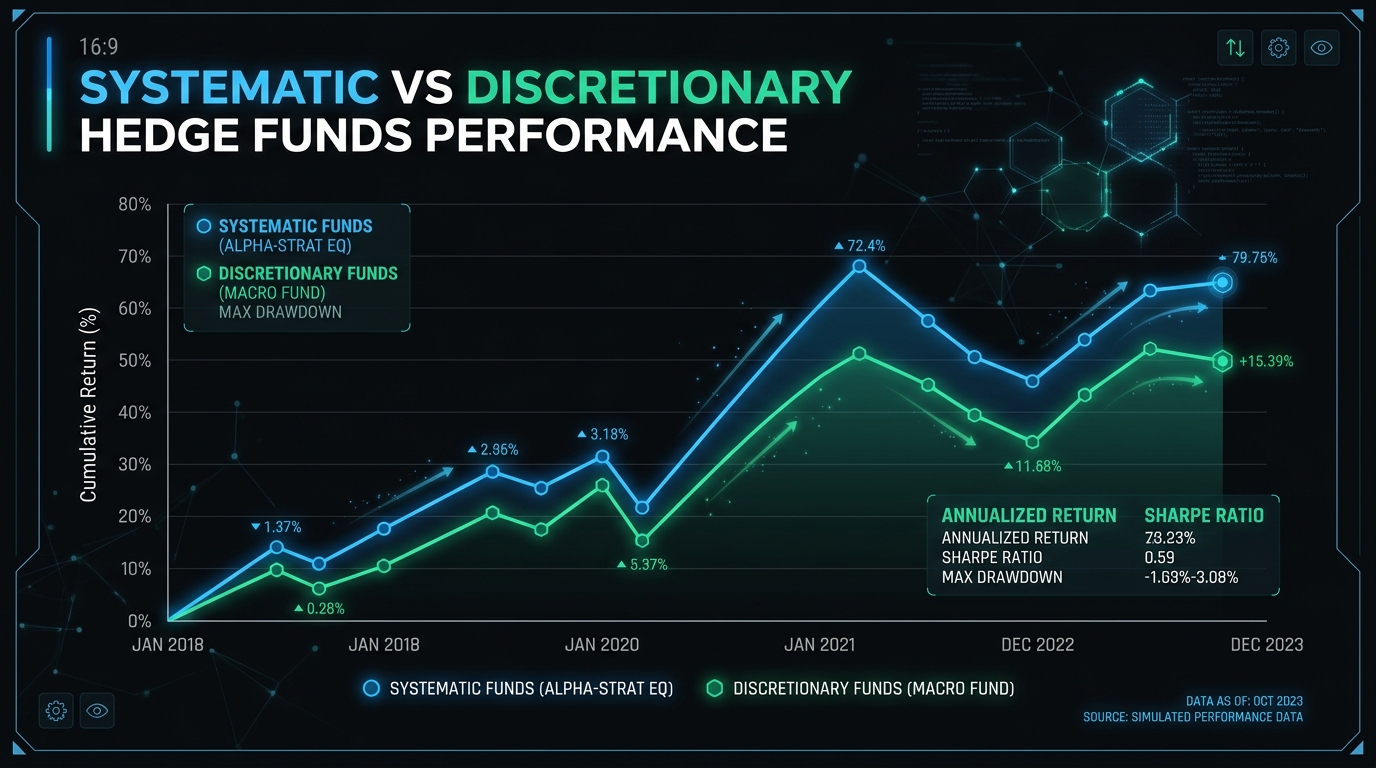
Systematic hedge funds, which rely on computer algorithms and quantitative models to make trading decisions, have largely thrived in the volatile environments of the past year. By removing human emotion and reacting instantly to vast datasets, these funds - such as those utilizing managed futures or CTA strategies - have consistently delivered strong uncorrelated returns. Conversely, discretionary funds rely on the intuition and analysis of human portfolio managers, often making high-conviction macroeconomic bets.
Performance Breakdown: Systematic vs. Discretionary
In the first half of 2026, systematic strategies, particularly trend-following CTAs, showed remarkable resilience. The Societe Generale CTA Index, a benchmark for managed futures, posted gains exceeding 8.5% by mid-year. Funds like Man AHL, Winton, and Two Sigma capitalized on trends across equities, foreign exchange, and precious metals. Their algorithms quickly adapted to shifting interest rate expectations and geopolitical shocks, capturing momentum where human traders might have hesitated.
Discretionary funds, championed by industry titans like Bridgewater Associates and Pershing Square, also saw successes, but their returns were often more uneven and highly dependent on specific macro calls. While a well-timed discretionary bet can yield massive windfalls, the consistency and risk-adjusted returns of top-tier systematic funds in 2026 have been compelling for institutional allocators seeking diversification.
| Fund Manager / Index | Strategy Type | Notable 2026 Performance Indicator |
|---|---|---|
| Man AHL | Systematic / Quant | Consistent positive alpha in trend-following |
| Winton Group | Systematic / CTA | Strong momentum capture in commodities |
| Bridgewater | Discretionary / Macro | Variable; reliant on specific global macro calls |
| DE Shaw | Hybrid / Quantamental | Robust returns blending data and human oversight |
| SG CTA Index | Benchmark (Systematic) | +8.54% YTD (as of July 2026) |
The Rise of the Hybrid "Quantamental" Approach
The clear lesson from 2026 is that the lines between systematic and discretionary are blurring. We are witnessing the rise of the "quantamental" approach - a fusion of quantitative data science and fundamental human analysis. Discretionary managers are increasingly employing alternative data, web scraping, and machine learning models to inform their intuition, while systematic funds are introducing human oversight to prevent algorithms from overfitting or misinterpreting unprecedented macro events.
This hybrid model aims to capture the best of both worlds: the processing power and emotional discipline of machines, paired with the nuanced contextual understanding of seasoned human investors. As AI integration deepens, we expect this convergence to accelerate, reshaping how alpha is generated.
The Role of Machine Learning in Modern Trading
Machine learning is no longer just a buzzword; it is the core engine driving the next generation of systematic returns. Modern funds are deploying advanced neural networks, including reinforcement learning for trading strategies, to adapt dynamically to market regimes. These models do not just follow static rules; they learn and evolve, identifying non-linear relationships in massive datasets that traditional statistical models might miss.
As we look toward the remainder of the decade, the hedge funds that successfully integrate cutting-edge machine learning into their core infrastructure - whether they identify as systematic, discretionary, or hybrid - will be the ones that dominate the performance tables.
Disclaimer: This article is for informational purposes only and does not constitute financial or investment advice. Hedge fund investments carry significant risks.