
TL;DR
- Differential privacy frameworks allow quantitative funds to share aggregated market signals without leaking proprietary strategies.
- Engineers balance the mathematical privacy-utility tradeoff to ensure data remains actionable for algorithmic models.
- The technology enables secure collaboration between competing financial institutions on systemic risk modeling.
- Implementation requires injecting calibrated statistical noise directly into high-speed trading data pipelines.
Related Insight: Time Series Foundation Models for Market Prediction
Related Insight: Bitcoin Hash Rate Hits All-Time High in August 2026
The Need for Secure Data Sharing
Quantitative trading firms operate in extreme secrecy. The exact parameters of a successful algorithmic strategy represent highly valuable intellectual property. Exposing raw trade execution data allows competitors to reverse-engineer these strategies, quickly destroying their profitability. However, the financial industry increasingly demands collaborative data analysis. Systemic risk modeling, alternative data validation, and joint academic research require institutions to pool their informational resources.
Differential privacy solves this structural conflict. It provides a mathematically rigorous guarantee that analyzing a dataset will not reveal the inclusion of any specific individual record. In the context of finance, this means an institution can share a dataset of aggregated trading signals. The mathematical guarantees ensure that no external party can isolate the specific trades, sizing, or timing of the original fund. This cryptographic assurance unlocks massive datasets for collaborative quantitative research.
The Math-Privacy-Utility Tradeoff
Implementing differential privacy requires navigating a strict mathematical tradeoff. The system protects privacy by injecting statistical noise into the data query results. The parameter epsilon controls the magnitude of this noise. A lower epsilon value means more noise, guaranteeing stronger privacy but severely degrading the accuracy of the data. A higher epsilon value preserves data accuracy but weakens the privacy guarantee.
Quantitative researchers must carefully calibrate this epsilon parameter based on the specific trading application. In low-frequency macroeconomic forecasting, models can tolerate significant noise without losing their predictive edge. Quants can aggressively protect the underlying data. Conversely, high-frequency statistical arbitrage models require extreme precision. Injecting too much noise destroys the subtle correlations driving the alpha. Finding the optimal epsilon requires extensive backtesting against historical market data .
Architecture of Privacy-Preserving Pipelines
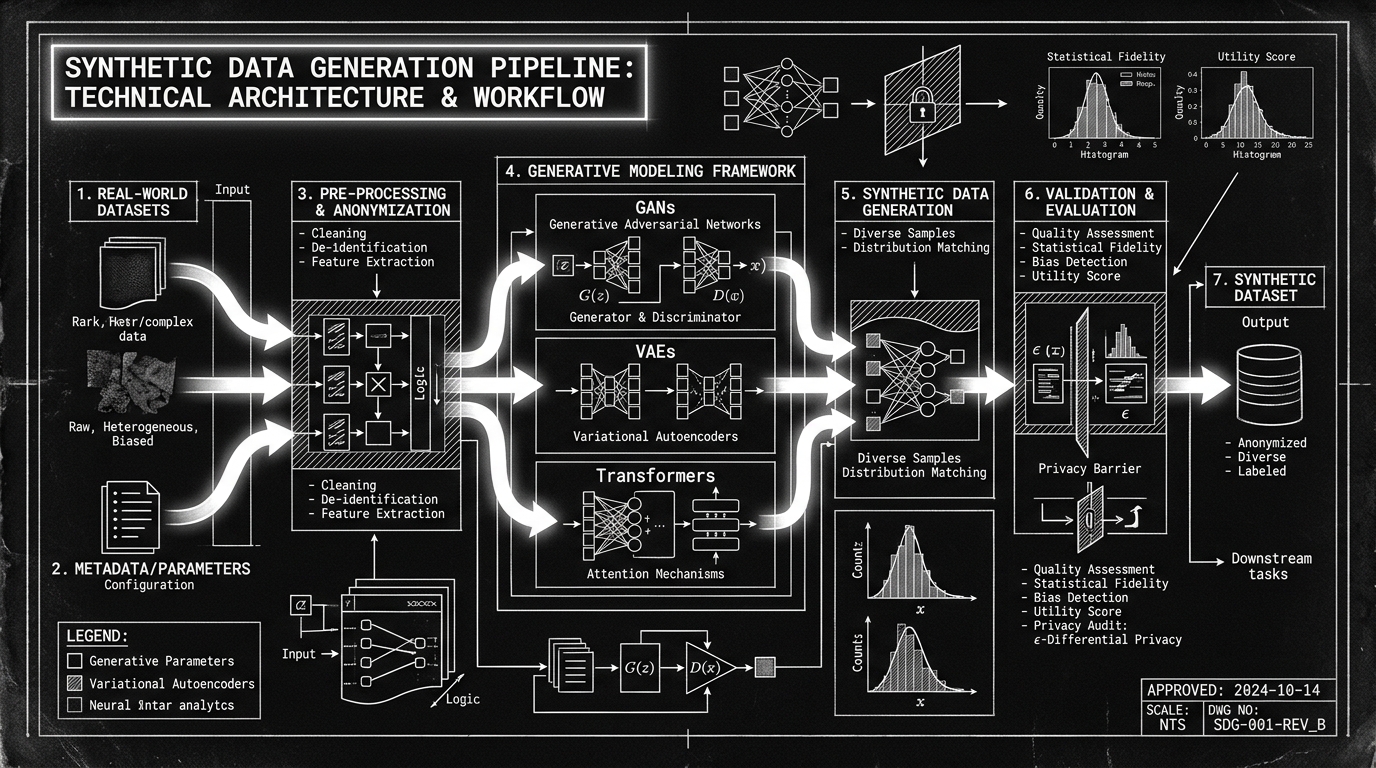
Integrating differential privacy into live trading pipelines demands sophisticated data engineering. Firms cannot simply add noise to static CSV files. They implement dynamic privacy layers directly above their core databases. When a researcher or external partner queries the database, the privacy engine intercepts the request. The engine calculates the required noise based on the query's sensitivity and injects it into the result set before returning the data.
This architecture tracks the cumulative privacy loss over time, a concept known as the privacy budget. Every query depletes a portion of this budget. If researchers run too many queries against the same dataset, the system locks access to prevent the eventual exposure of the raw data. Managing this privacy budget forces quantitative teams to optimize their research workflows. They must extract maximum insight from a limited number of model iterations.
Collaborative Alpha Generation
Differential privacy enables new forms of collaborative alpha generation. Prime brokerages aggregate the execution data of hundreds of hedge fund clients. By applying differential privacy, the broker generates a secure dataset reflecting broad institutional sentiment. They sell these aggregated signals back to their clients as a premium data feed. The participating funds benefit from the collective intelligence without compromising their individual positions.
Consortiums of smaller trading firms use the technology to pool alternative data sources. Acquiring satellite imagery or credit card transaction data is prohibitively expensive for single firms. By pooling resources and analyzing the combined data through differential privacy frameworks, smaller quants compete with massive multi-strategy funds. The technology democratizes access to advanced data analytics while maintaining strict competitive boundaries.
Regulatory Compliance and Auditability
Regulators increasingly expect financial institutions to adopt advanced cryptographic techniques to protect client data. Traditional anonymization methods, like removing names and account numbers, frequently fail against modern de-anonymization attacks. Differential privacy provides a mathematically provable defense against these attacks. Compliance departments rely on the framework to safely transmit sensitive market data to global regulatory bodies.
The rigorous mathematical foundation of differential privacy simplifies the audit process. Firms can definitively prove to regulators the exact level of privacy protection applied to any dataset. This transparency builds trust with regulators and institutional investors. As global data sovereignty laws become more stringent, differential privacy will transition from a specialized quantitative tool into a mandatory infrastructure requirement for all global trading operations.
Disclaimer: The information provided in this article is for educational and informational purposes only and does not constitute financial, investment, or trading advice. Algorithmic trading and the use of AI in finance involve significant risks. Readers should consult with a qualified financial advisor before making any investment decisions.