
TL;DR
- Massive Accuracy Gains: GNNs can reduce false positives by up to 200% compared to legacy rules-based engines, saving billions in lost legitimate transaction revenue.
- Speed of Detection: Advanced frameworks process millions of node connections in sub-50 milliseconds, enabling true real-time payment authorization without noticeable lag.
- Network-Level Defense: Instead of isolated transaction scoring, GNNs uncover complex fraud rings and money mule networks by analyzing shared device IDs, IPs, and historical linkages.
Why Graph Structure Matters for Fraud
In the modern financial ecosystem, fraud is rarely a solitary endeavor. Cybercriminals operate in sophisticated networks, utilizing vast arrays of synthetic identities, stolen credentials, and proxy servers to execute coordinated attacks. Traditional machine learning models, such as Random Forests or Gradient Boosting Machines (GBMs), analyze transactions in a tabular format, treating each event as an isolated data point. While effective at spotting basic anomalies, these models struggle to comprehend the broader structural context of a transaction.
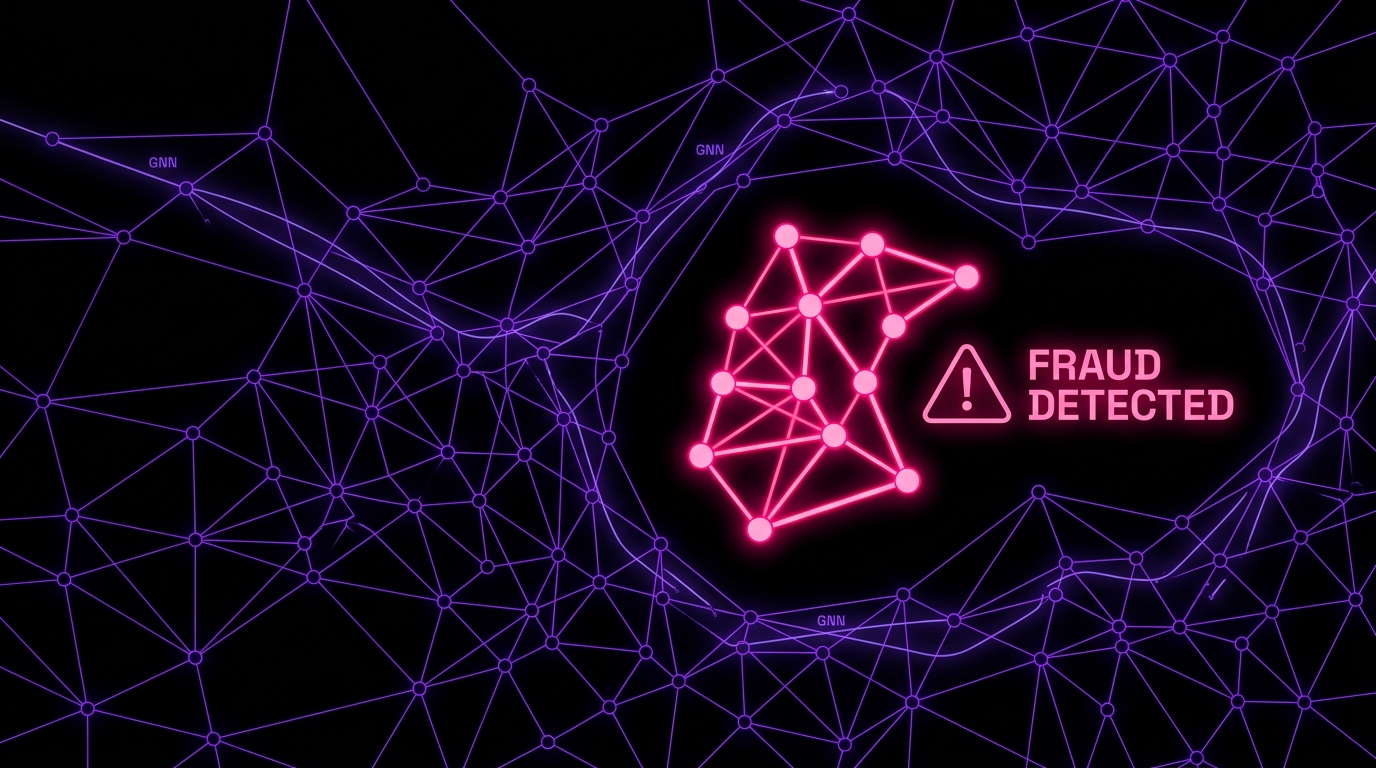
This is where Graph Neural Networks (GNNs) represent a . By representing data as a graph - where entities like users, devices, and merchants are "nodes," and their interactions are "edges" - GNNs inherently understand relationships. A transaction is no longer just a row of features; it is a connection between a specific IP address, a device footprint, and a merchant account, all of which have their own histories and connections. If a single device ID has been linked to fifty different user accounts over the past week, a graph structure highlights this anomaly immediately, whereas a tabular model might miss the connection if the transactions were spaced out or fell just below individual threshold triggers.
The importance of this structural awareness cannot be overstated. Modern fraud techniques, such as authorized push payment (APP) scams and complex money laundering operations, rely on obfuscation through multiple hops and synthetic nodes. GNNs effectively pierce this veil by evaluating the "neighborhood" of any given entity. This structural intelligence allows financial institutions to move from reactive, rules-based defense to proactive, network-level threat detection, fundamentally altering the economics of cybercrime.
GNN Fundamentals: Nodes, Edges, and Message Passing
To understand why GNNs are so effective, it is essential to grasp their underlying mechanics. The foundation of any graph database is its entities and their relationships. In a financial context, nodes can represent bank accounts, credit cards, physical addresses, IP addresses, or mobile device fingerprints. Edges represent the relationships or actions connecting them, such as a money transfer, a login event, or a shared mailing address. Each node and edge can possess its own set of features (e.g., transaction amount, time of day, account age).
The core operational mechanism of a GNN is "message passing." During the training and inference phases, nodes iteratively exchange information with their neighbors. For instance, an account node will aggregate feature data from all the device nodes and transaction edges it is connected to. In the next layer of the neural network, it aggregates data from its neighbors' neighbors. This recursive aggregation allows the model to build a highly contextualized embedding for every node in the network. A seemingly innocuous account might suddenly appear highly suspicious if the message-passing process reveals that its immediate network is closely tied to known fraudulent entities.
This process is computationally intensive, but modern advancements in parallel processing and optimized graph algorithms have made it viable for enterprise use. By leveraging message passing, GNNs capture both the localized features of a transaction and the global topology of the financial network. It bridges the gap between macro-level network analysis and micro-level entity scoring, providing a holistic view of systemic risk that is mathematically impossible to achieve with traditional, non-relational architectures.
Advanced Architectures: GraphSAGE and Graph Attention Networks
As the financial sector has adopted GNNs, specific architectural frameworks have emerged as industry standards, each tailored to solve unique challenges of scale and accuracy. GraphSAGE (Graph Sample and Aggregatem) is one of the most prominent. Traditional GNNs require the entire graph structure to be present in memory during training, which is unfeasible for a global payment network with billions of nodes. GraphSAGE solves this by learning a function that generates embeddings by sampling and aggregating features from a node's local neighborhood. This inductive approach allows the model to generate accurate predictions for entirely new, unseen nodes - a critical capability for real-time fraud detection where new accounts and devices appear constantly.
Another critical advancement is the Graph Attention Network (GAT). Not all connections in a financial network carry the same weight. A shared IP address at a public coffee shop is far less indicative of fraud than a shared unique device IMEI number. GATs introduce an "attention mechanism" that allows the model to assign different weights to different neighboring nodes during the message-passing phase. By learning which relationships are most critical for identifying fraudulent behavior, GATs significantly improve model precision and reduce the noise inherent in massive, densely connected financial datasets.
These architectures are often combined or customized by internal data science teams to fit specific operational requirements. For example, temporal GNNs incorporate the dimension of time, analyzing how graph structures evolve over seconds, minutes, and days. This is particularly useful for detecting coordinated "burst" attacks, where a fraud ring activates hundreds of synthetic accounts simultaneously. The continuous evolution of these architectures ensures that GNNs remain at the bleeding edge of adversarial machine learning.
Real Deployments: PayPal, Mastercard, and Stripe
Theoretical superiority means little without real-world validation, and the deployment of GNNs by the world's largest payment processors serves as a definitive endorsement of the technology. PayPal, managing hundreds of millions of active accounts, has been a pioneer in this space. They have transitioned significantly from legacy gradient boosting machines to deeply integrated GNN pipelines. By utilizing real-time graph databases like Aerospike, PayPal maps complex relationships - such as "asset sharing" where multiple risky accounts link to a single device - detecting sophisticated fraud rings that previously evaded their tabular models.
Mastercard has aggressively integrated AI into its fraud detection ecosystem, explicitly highlighting the role of generative AI and advanced network analysis. Their Decision Intelligence platform evaluates over a hundred billion transactions annually. By leveraging AI to understand the behavioral biometrics and structural network of a transaction, Mastercard reported a doubling of their detection speed for compromised cards and up to a 200% reduction in false positives. This massive reduction in "insult rate" - where a legitimate customer's card is declined - preserves billions in revenue for merchants and issuers.
Stripe, similarly, has heavily invested in graph-based machine learning for its Radar product. Processing payments for millions of online businesses, Stripe's graph models evaluate the global network of transactions to score risk dynamically. If a credit card was used fraudulently on one merchant's site, the structural awareness of the GNN immediately flags related entities across the entire Stripe ecosystem. These real-world deployments highlight that GNNs are no longer experimental; they are the foundational infrastructure protecting the modern digital economy.
Performance Uplift vs Traditional Gradient Boosting
The transition from legacy models to GNNs is driven by measurable, significant uplifts in performance metrics. Traditional Gradient Boosting Machines (GBMs) like XGBoost or LightGBM have long been the workhorses of financial risk modeling. However, when benchmarked against GNNs on complex, network-driven fraud datasets, the limitations of GBMs become starkly apparent. GNNs consistently outperform traditional models in detecting coordinated attacks, money laundering networks, and synthetic identity rings.
| Metric | Traditional ML (e.g., XGBoost) | Graph Neural Networks (GNN) | Performance Uplift |
|---|---|---|---|
| False Positive Rate (FPR) | High (~5-8%) | Very Low (~1.5-2%) | Up to 200% Reduction |
| Recall (Fraud Captured) | Moderate (Misses network fraud) | High (Captures complex rings) | 25-40% Improvement |
| Feature Engineering Effort | Very High (Manual aggregation) | Low (Automated via message passing) | Significant Time Savings |
| Cold Start Detection | Poor (Relies on historical data) | Excellent (Uses network context) | Highly Effective |
| Latency (Inference) | Ultra-Low (<10ms) | Low (<50ms, highly optimized) | Comparable for Production |
The table above illustrates the dramatic improvements observed in production environments. The most impactful metric is the reduction in False Positive Rates (FPR). Every false positive represents a frustrated customer, a lost sale, and a potential loss of lifetime value for the merchant. By utilizing the deep contextual awareness of GNNs, financial institutions can confidently approve more borderline transactions, driving top-line growth while simultaneously minimizing actual fraud losses.
Furthermore, GNNs automate much of the complex feature engineering that previously consumed data science resources. Instead of manually crafting features like "number of accounts sharing this IP in the last 24 hours," the GNN inherently learns these relational dynamics through its architecture. As the financial sector continues to digitize and fraud networks become more sophisticated, the structural intelligence provided by Graph Neural Networks will be the defining factor in the ongoing arms race between financial institutions and global cybercrime.
For more insights into how advanced data strategies are reshaping finance, explore our analysis on how alternative data is used by hedge funds.
Disclaimer: This article is for informational purposes only and does not constitute financial, investment, or technical implementation advice. Security protocols and algorithms discussed are illustrative of industry trends.