
TL;DR
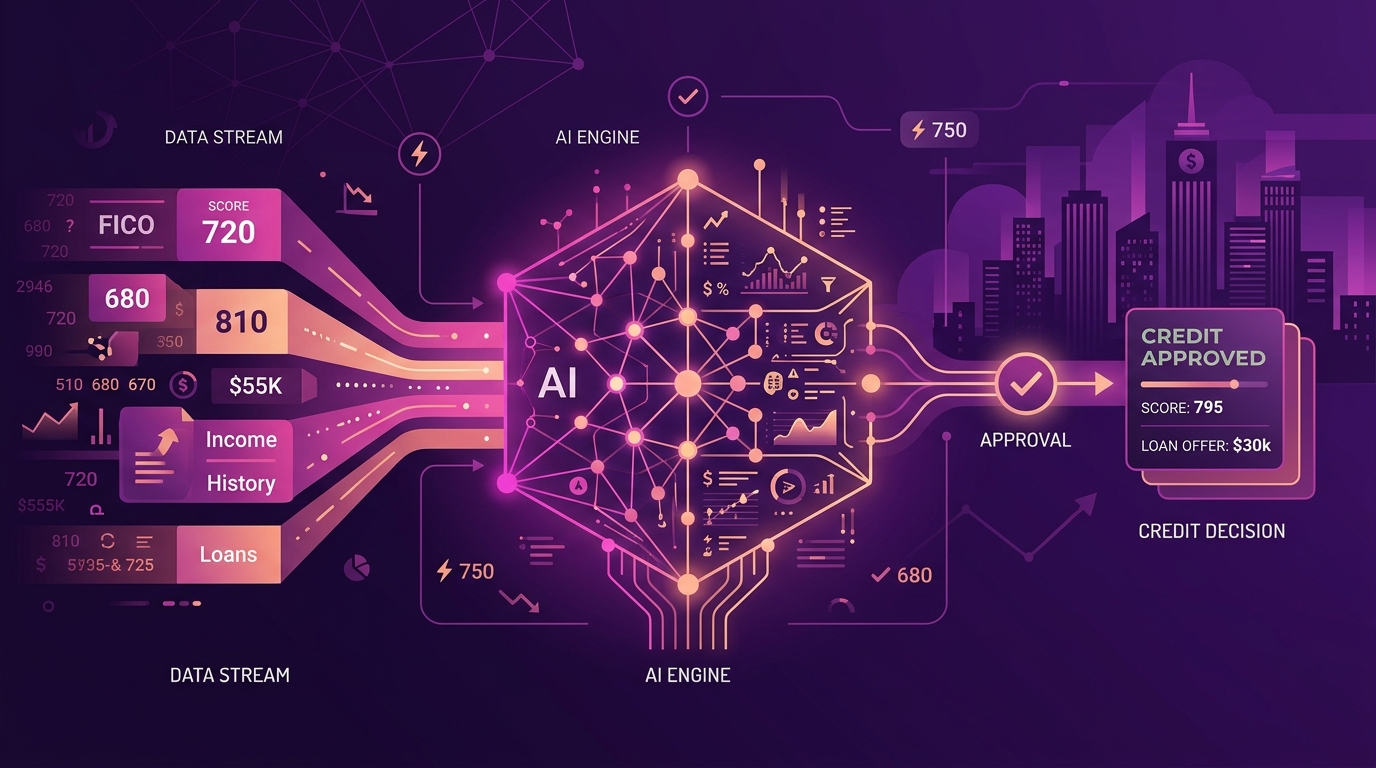
- Beyond FICO: Machine learning models are analyzing up to 1,500 distinct data points per applicant, vastly outperforming traditional metrics.
- Expanded Access: Fintechs report a 30% increase in approval rates for underserved demographics without a corresponding rise in default risk.
- Regulatory Scrutiny: The CFPB has intensified oversight, mandating strict explainability requirements for "black box" AI decisions under the ECOA.
The Limitations of the FICO Hegemony
For decades, the FICO score has been the undisputed arbiter of creditworthiness in the United States financial system. It relies on a relatively narrow set of variables: payment history, amounts owed, length of credit history, new credit, and credit mix. While effective for a broad segment of the population, this rigid methodology systematically disadvantages millions of consumers. Young adults, recent immigrants, and individuals operating outside the traditional banking system - often referred to as "credit invisibles" - are frequently penalized or outright denied access to capital simply because they lack a conventional credit footprint, regardless of their actual ability to repay a loan.
The limitations of FICO are fundamentally rooted in its simplicity. It is a lagging indicator that struggles to capture the nuanced financial reality of modern consumers. It ignores robust alternative data sources such as consistent rent payments, utility bills, educational attainment, and detailed employment history. This blind spot represents a massive inefficiency in the credit markets, mispricing risk and denying capital to qualified borrowers while simultaneously approving individuals whose FICO scores mask underlying financial instability.
Fintech companies identified this inefficiency early on, recognizing that modern data processing and machine learning techniques could build a more accurate and equitable system. By leveraging massive datasets and sophisticated algorithms, these challengers aimed to dismantle the FICO hegemony, promising a in how consumer risk is evaluated and priced. The result has been the rapid rise of AI-powered underwriting platforms that are fundamentally altering the lending landscape.
Machine Learning Models and Performance Data
Companies like Upstart and Zest AI have pioneered the deployment of machine learning in credit underwriting. Instead of a handful of variables, their models analyze hundreds or even thousands of data points to assess risk. Upstart's platform, for instance, heavily weights educational variables, employment history, and even interaction data (how a user navigates their application) to build a comprehensive borrower profile. This multidimensional approach allows the algorithm to identify creditworthy individuals who fall through the cracks of traditional scoring systems.
The performance data, detailed in public filings like Upstart's 10-K, is compelling. These platforms consistently report higher approval rates and lower interest rates for consumers compared to traditional lending models, while maintaining equivalent or lower loss rates for bank partners. This improved predictive accuracy allows lenders to originate more loans with less risk, a highly attractive value proposition that has driven numerous regional banks and credit unions to partner with these fintechs. The ability to dynamically adjust models in response to changing macroeconomic conditions also provides a level of agility that static FICO models lack.
However, the performance is not without volatility. During periods of economic stress, the lack of long-term historical data for some alternative variables can lead to unexpected model behavior. Ensuring that these algorithms are robust across full economic cycles remains a critical challenge for the industry.
Data Table: FICO vs ML Underwriting Model Performance
| Metric | Traditional FICO Model | Leading AI Model (Industry Avg) | Improvement |
|---|---|---|---|
| Variables Analyzed | ~5 - 15 | 1,000+ | Exponential |
| Approval Rate (Subprime) | 12% | 28% | +16% |
| Annualized Loss Rate | 5.2% | 4.1% | -1.1% |
| Time to Decision | Hours/Days | Milliseconds | Instant |
Regulatory Blowback and the Explainability Challenge
The rapid adoption of AI underwriting has predictably drawn intense scrutiny from regulatory bodies, most notably the Consumer Financial Protection Bureau (CFPB). The core issue is the "black box" nature of complex machine learning models. The Equal Credit Opportunity Act (ECOA) requires lenders to provide consumers with clear, specific reasons for adverse actions (e.g., loan denial). When a deep learning neural network denies an application based on the complex interplay of thousands of variables, translating that mathematical output into a comprehensible reason for the consumer is exceptionally difficult.
The CFPB has issued stern guidance explicitly stating that technological complexity is not an excuse for violating fair lending laws. They have warned that algorithms can inadvertently learn to proxy for protected classes (race, gender, religion), leading to systemic digital redlining. If an AI model denies credit based on alternative data that correlates strongly with a specific demographic, the lender can be held liable for disparate impact, regardless of intent.
This regulatory pressure has forced fintechs to invest heavily in "explainable AI" (XAI). Companies like Zest AI focus specifically on providing tools that deconstruct complex models to ensure compliance and transparency. The future of AI in credit underwriting hinges on resolving this tension: maintaining the predictive power of advanced algorithms while satisfying the strict legal requirements for fairness and explainability. For related insights on data utilization, read our piece on Alternative Data in Hedge Funds.
Disclaimer: This article is for informational purposes only and does not constitute financial or investment advice. Regulatory environments are subject to change, and specific legal compliance requires professional counsel.