

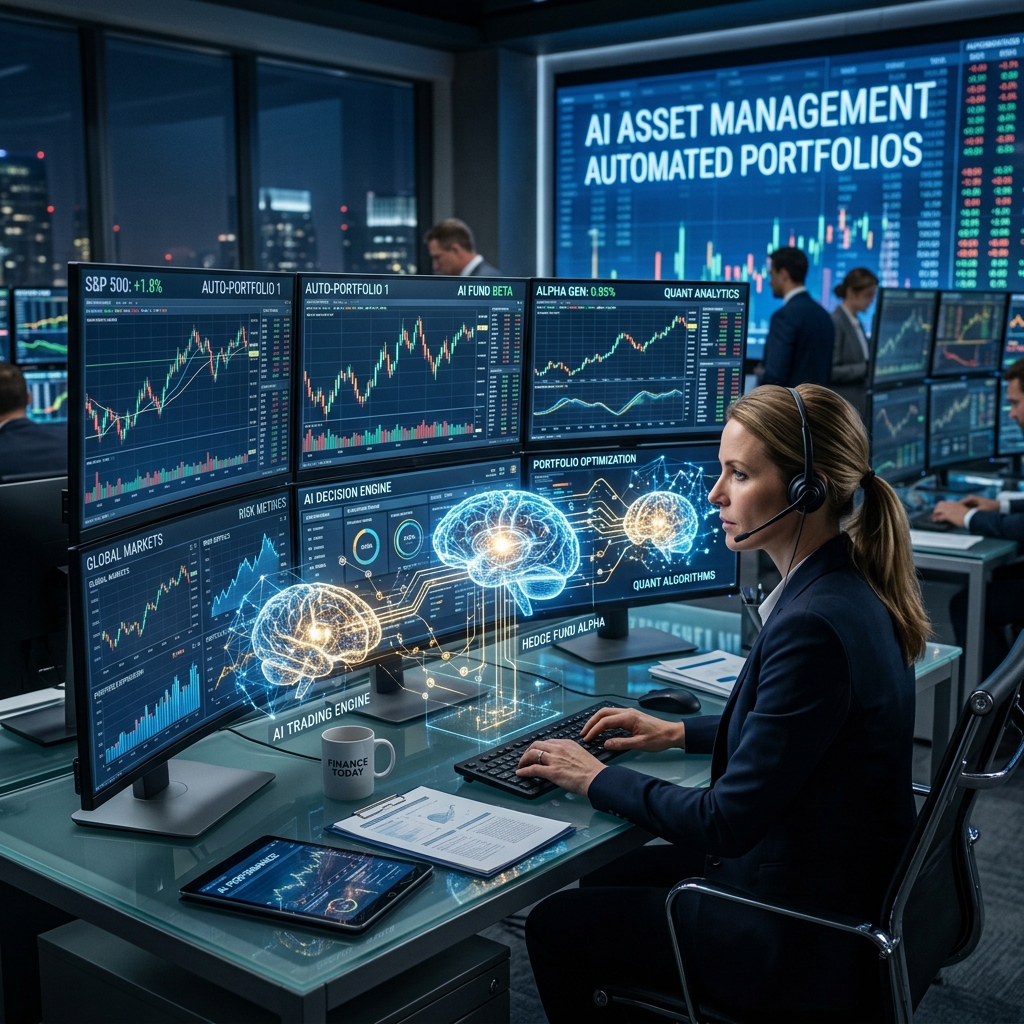
Automated Portfolio Management: When AI Beats Human Hedge Funds
The financial landscape is undergoing a seismic shift. For decades, the towering figures of Wall Street - the star portfolio managers and legendary hedge fund titans - relied on a mix of experience, intuition, and exhaustive fundamental analysis to beat the market. Today, a new class of managers is taking over, and they don't sleep, don't let emotions dictate their trades, and can process billions of data points in milliseconds. We are in the era of automated portfolio management, where Artificial Intelligence (AI) and machine learning algorithms are consistently proving their ability to outsmart human hedge funds.
The Rise of AI in Quantitative Strategies
Quantitative trading is not new; "quants" have been utilizing mathematical models since the 1980s. However, traditional quant models were largely static, built on historical rules created by human programmers.
Enter Artificial Intelligence and Machine Learning. Modern AI-driven quantitative strategies go far beyond simple rule-based algorithms. These systems employ Deep Learning, Natural Language Processing (NLP), and Neural Networks to:
- Analyze Alternative Data: AI algorithms can ingest and make sense of unstructured data - such as satellite imagery of retail parking lots, global shipping manifests, social media sentiment, and earnings call transcripts - extracting actionable insights long before a human analyst could read the first page.
- Identify Hidden Patterns: Financial markets are complex, non-linear systems. Machine learning models excel at identifying subtle, complex correlations across diverse asset classes that are entirely invisible to the human eye.
- Continuous Learning: Unlike static models, AI algorithms learn and adapt in real-time. As market conditions shift, the algorithms adjust their strategies, optimizing for new volatility regimes or macroeconomic trends.
The Advantages of Automated Portfolio Management
Why are AI-driven funds increasingly outperforming their human counterparts? The advantages are structural and profound:
1. Emotionless Execution
Fear and greed are the twin enemies of the human investor. Even the most seasoned hedge fund managers are susceptible to behavioral biases, often holding onto losing positions too long or panic-selling during a downturn. AI algorithms execute trades purely on statistical probabilities and pre-defined risk parameters. There is no ego, no panic, and no hesitation.
2. Unprecedented Speed and Scale
A human team can only track a limited number of stocks or macroeconomic indicators at any given time. An AI system can monitor millions of data points across global markets simultaneously, executing thousands of trades in fractions of a second to capitalize on fleeting arbitrage opportunities.
3. Cost Efficiency
Managing a traditional hedge fund is expensive. The infrastructure requires armies of analysts, researchers, and traders, all demanding hefty salaries and bonuses. Automated portfolio management drastically reduces these overhead costs. A lean team of data scientists and engineers can oversee an AI system that manages billions of dollars in AUM (Assets Under Management).
4. Dynamic Risk Management
AI models are uniquely equipped for advanced risk management. By simulating millions of market scenarios (Monte Carlo simulations) and constantly stress-testing portfolios against real-time data, AI can dynamically adjust hedge ratios and position sizing to protect capital during unforeseen market shocks.
Real-World Performance: AI vs. Human Managers
The proof is in the performance. While human stock-pickers have historically struggled to consistently beat the S&P 500 - especially net of their notorious "2 and 20" fee structures - AI-driven funds are delivering compelling results.
In recent years of extreme market volatility - ranging from pandemic shocks to inflationary spikes - purely algorithmic funds have often provided superior downside protection and uncorrelated returns. By exploiting micro-inefficiencies and rapidly adapting to changing macroeconomic data, AI strategies have generated consistent alpha where human managers were blindsided by structural shifts in the market.
The Future: Will AI Replace Hedge Fund Managers?
So, is the human hedge fund manager obsolete? Not entirely, but their role is fundamentally changing. The future of finance lies in the "quantamental" approach - a hybrid model where human intuition guides the overarching strategy, while AI handles the data processing, pattern recognition, and trade execution.
Human managers will transition from being stock-pickers to being architects of algorithmic systems. They will be responsible for asking the right questions, defining the parameters of the AI, and managing the ethical and systemic risks associated with algorithmic trading.
Conclusion
Automated portfolio management is no longer a futuristic concept; it is the current reality of high-level finance. As AI-driven quantitative strategies continue to evolve and ingest even larger datasets, the gap between algorithmic performance and human capabilities will likely widen. For investors seeking an edge in increasingly complex global markets, the question is no longer whether to trust a machine with their money, but rather, which machine is the smartest.
Keywords: Automated portfolio management, AI hedge funds, quantitative strategies, machine learning in finance, algorithmic trading, financial AI, quantamental investing, fintech.