
TL;DR
- Massive Exposure: The Bank for International Settlements (BIS) estimates that over $500 billion in global cross-border bank credit is linked to yen carry trades, highlighting the sheer scale of potential market contagion.
- BoJ Policy Shift: With the Bank of Japan recently holding short-term interest rates at 1.0% and signaling a hawkish stance for 2026, the era of ultra-cheap yen funding is decisively ending.
- Asset Vulnerability: Emerging market currencies, particularly the Mexican Peso and Brazilian Real, face up to 15% downward pressure if the aggressive unwind trajectory continues through the remainder of the year.
The Mechanics of the Carry Trade
The currency carry trade is one of the most fundamental strategies in global finance. It involves borrowing capital in a currency with a remarkably low interest rate - historically, the Japanese yen or the Swiss franc - and investing those funds in a higher-yielding asset or currency. The investor profits from the interest rate differential, or the "carry," provided that the exchange rate between the two currencies remains stable or moves in the investor's favor.
For decades, the Japanese yen has been the undisputed king of funding currencies. The Bank of Japan (BoJ) implemented an aggressive ultra-loose monetary policy, maintaining interest rates at zero or negative levels to combat chronic deflation. This created an environment where global investors, from massive hedge funds to retail traders, could borrow yen essentially for free and deploy it into high-yielding emerging market bonds, tech stocks, or real estate. The sheer volume of these trades integrated the yen into the deepest layers of global market liquidity.
However, the strategy carries a hidden, asymmetrical risk profile often described as "picking up pennies in front of a steamroller." While the returns are steady and incremental under stable conditions, sudden volatility in the exchange rate can wipe out years of carry profit in a matter of days. When the funding currency sharply appreciates, the cost of repaying the borrowed funds skyrockets, forcing traders to liquidate their high-yielding assets simultaneously, which triggers a chaotic market unwind.
Scale of the Yen Carry Trade and BoJ's Rate Path
Estimating the exact size of the yen carry trade is notoriously difficult because much of the activity occurs off-balance-sheet via derivatives and FX swaps. However, the Bank for International Settlements (BIS) frequently attempts to quantify it. Recent reports suggest that yen-denominated cross-border bank claims exceed half a trillion dollars. When factoring in the shadow banking sector, hedge funds, and family offices, the true notional exposure is likely significantly higher, making it a systemic linchpin in global finance.
The catalyst for the current unwinding is the definitive shift in the Bank of Japan's monetary policy. In its July 2026 meeting, the BoJ maintained its short-term interest rate at 1.0%, but the accompanying policy statement was undeniably hawkish. Governor Kazuo Ueda signaled that underlying inflation could deviate above the 2% target, indicating that further rate hikes are firmly on the table. This represents a monumental departure from the zero-interest-rate policy (ZIRP) era.
As the BoJ tightens, the interest rate differential between Japan and the rest of the world naturally narrows. For context, you can read more about how this interacts with global central bank policy in our analysis of the Fed Rate Path 2026 and Bond Market Implications. When the cost of borrowing yen increases, the fundamental math of the carry trade breaks down, prompting a structural, rather than speculative, exit from the strategy.
Contagion Path: Assets Hit When the Carry Unwinds
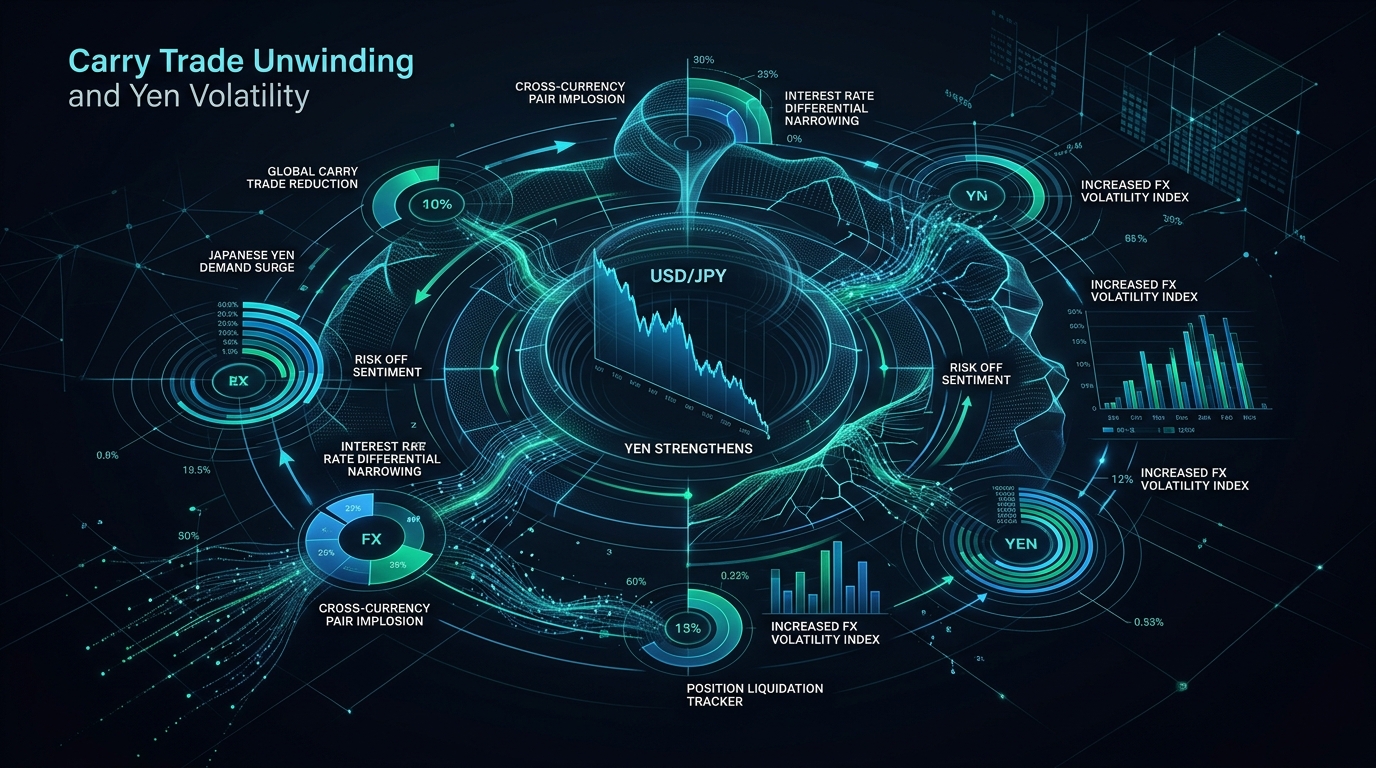
When a massive carry trade unwinds, the contagion spreads far beyond the foreign exchange markets. The initial phase involves the aggressive repurchasing of the yen, which drives its value up even faster in a self-fulfilling feedback loop. Simultaneously, traders must sell their target assets to generate the liquidity needed to close their yen liabilities. This forced selling puts immense downward pressure on historically popular carry target assets.
Emerging market (EM) currencies are usually the first casualty. Currencies like the Mexican Peso, the Brazilian Real, and the South African Rand have historically offered attractive yields and have been prime targets for yen-funded trades. As the unwind accelerates, capital aggressively flows out of these emerging markets, leading to sudden currency depreciation and rising borrowing costs for EM governments, a dynamic closely monitored by the IMF World Economic Outlook.
The equity markets are also highly vulnerable. Much of the cheap yen funding over the last few years has found its way into global equities, particularly high-growth US technology stocks. A synchronized unwind forces institutional investors to reduce their leverage, leading to indiscriminate selling across tech-heavy indices. The 2024 carry trade blowup case study serves as a stark reminder: when the yen surged unexpectedly, it triggered a multi-day selloff in global equities, wiping out trillions in market capitalization before central banks stepped in to calm the markets.
| Funding Currency | Target Asset / Currency | Historical Yield Differential | Vulnerability to Unwind |
|---|---|---|---|
| Japanese Yen (JPY) | Mexican Peso (MXN) | 8.5% - 11.0% | Very High |
| Japanese Yen (JPY) | Brazilian Real (BRL) | 9.0% - 10.5% | High |
| Swiss Franc (CHF) | US Tech Equities (Nasdaq) | Variable (Capital Apprec.) | Medium |
| Japanese Yen (JPY) | US Treasuries (Long Duration) | 3.5% - 5.0% | Medium |
Hedging Carry Trade Risk in 2026
Given the systemic risks, institutional investors are increasingly focusing on robust hedging strategies. The traditional approach is to use FX options, specifically out-of-the-money (OTM) call options on the funding currency. If the yen surges unexpectedly, these options provide a non-linear payout that offsets the losses incurred on the short yen position, effectively acting as disaster insurance.
Another approach involves dynamic position sizing and cross-asset correlation monitoring. Quantitative funds continuously monitor the correlation between the yen and their target assets. When the negative correlation breaks down - meaning the yen and the target asset are moving in the same direction - it serves as an early warning signal of an impending liquidity shock. This prompts algorithms to automatically scale down leverage and reduce exposure before the broader market recognizes the shift.
Ultimately, the era of the "set it and forget it" carry trade is over. With the Bank of Japan normalizing rates and global macroeconomic uncertainty elevated, the focus has shifted from maximizing yield to aggressive risk management. The institutions that survive the next wave of volatility will be those that deeply understand the hidden leverage within their portfolios and have structured their operations to withstand sudden, sharp liquidity contractions.
Disclaimer: This article is for informational purposes only and does not constitute financial or investment advice. Always consult with a qualified professional before making any investment decisions.