

verified: true
TL;DR
- The SEC finalized its comprehensive overhaul of the crypto custody framework in late 2026, defining stringent requirements for qualified custodians.
- State-chartered trust companies face new compliance hurdles, while federal banks receive a clearer mandate to offer digital asset safekeeping.
- The regulation significantly alters the algorithmic trading landscape by establishing regulated collateral networks.
- Hedge funds must restructure their prime brokerage relationships to ensure compliance with the mandatory segregation of client assets.
The Overhaul of Institutional Custody Standards
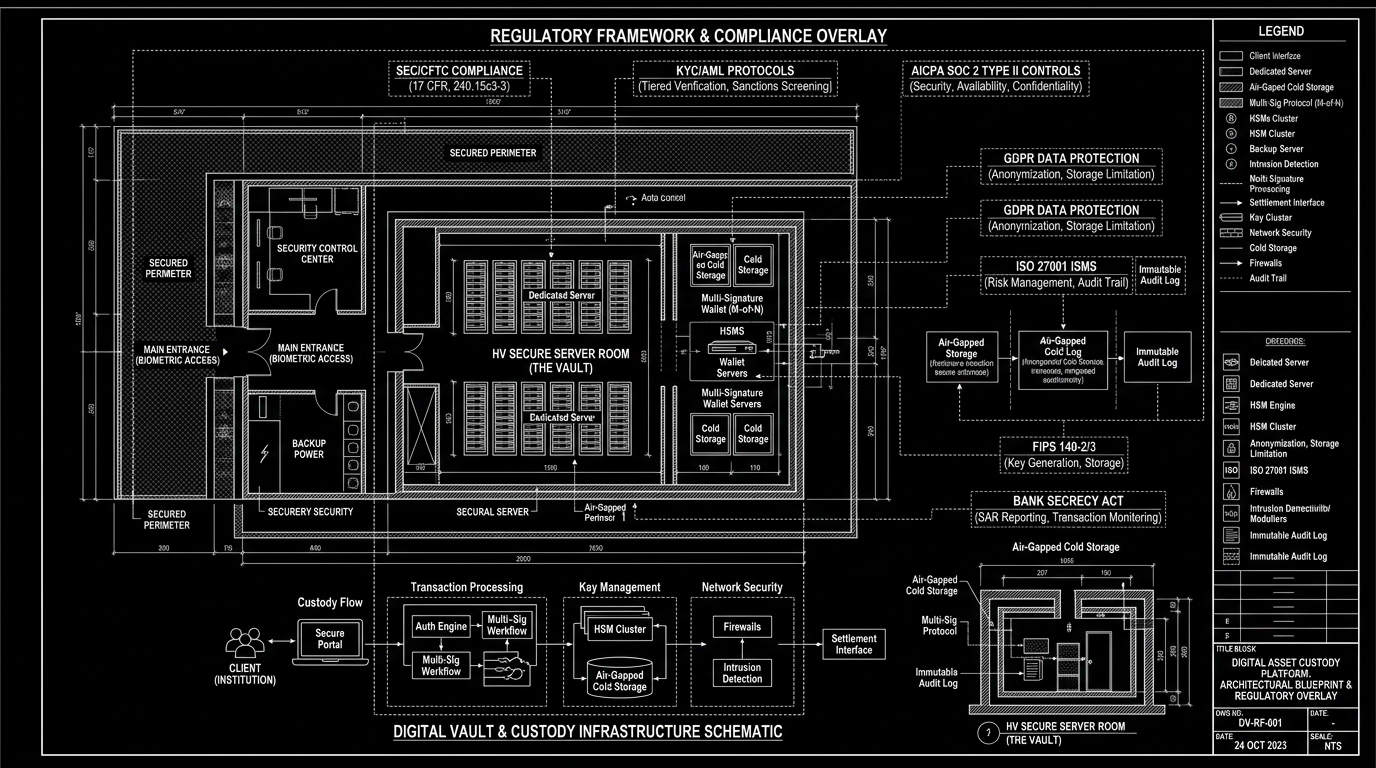
The Securities and Exchange Commission (SEC) radically restructured the regulatory framework governing digital asset custody in 2026. The finalized rulemaking addresses years of ambiguity surrounding the definition of a qualified custodian in the digital age. Under the new regime, investment advisers must maintain client digital assets with institutions possessing specific federal or state charters. These institutions must undergo continuous cryptographic audits and maintain rigorous capitalization ratios.
The directive directly supersedes the controversial Staff Accounting Bulletin 121 (SAB 121). The previous bulletin effectively barred highly regulated financial institutions from offering crypto custody by requiring them to hold equivalent capital against digital assets on their balance sheets. The 2026 framework removes this capital penalty provided the custodian maintains absolute bankruptcy-remote segregation of client keys. This structural pivot allows major Wall Street banks to formally enter the digital asset safekeeping business without crippling capital charges.
For asset managers managing over $100 million, compliance is mandatory and immediate. The rule requires strict separation between trade execution venues and custodial services. This decoupling targets the vertically integrated exchange models that dominated the early cryptocurrency industry. By enforcing this market structure, the SEC aims to eliminate the commingling risks that historically triggered catastrophic contagion events across the sector.
Impact on Prime Brokerage and Capital Efficiency
The separation of custody from execution alters the mechanics of institutional crypto trading. Hedge funds and algorithmic trading desks previously relied on centralized exchanges to hold collateral while simultaneously executing trades. The new rule forces a transition toward off-exchange settlement models. Traders must now park assets with a qualified custodian while using specialized networks to reflect those balances on trading venues.
This structural shift introduces new complexities for high-frequency trading (HFT) strategies. Moving assets between a regulated custodian and a trading venue introduces latency and transaction costs. To solve this, prime brokers are developing cryptographic sub-account structures that allow instantaneous settlement without exposing the underlying private keys to the execution layer. Quantitative models must now account for collateral mobility constraints and the specific settlement timelines dictated by these new custodian networks.
The rule also reshapes the decentralized finance (DeFi) interactions of regulated funds. The SEC explicitly mandated that qualified custodians must demonstrate exclusive control over client assets. This requirement creates severe friction for yield farming strategies that require funds to lock assets in automated smart contracts. Compliance officers are actively working with prime brokers to establish whitelisted multi-signature setups that satisfy the regulatory definition of control while permitting limited interactions with approved decentralized liquidity pools.
Algorithmic Arbitrage in a Fragmented Market
The strict segregation requirements create new opportunities for quantitative arbitrage desks. As institutional capital migrates toward bank-grade custodians, liquidity pools will likely fragment across different settlement networks. Retail volume may remain concentrated on offshore exchanges, while institutional volume aggregates on execution venues integrated with Wall Street custodians. Price discrepancies between these distinct liquidity silos provide fertile ground for basis trading and statistical arbitrage.
Trading algorithms must adapt to monitor order book depth across a bifurcated market structure. A liquidity shock on a retail-heavy exchange might not immediately propagate to the institutional execution venues due to the friction of moving collateral through qualified custodians. Quants who accurately model the latency of these asset transfers can systematically capture the resulting price premiums. The cost of capital for executing these arbitrage strategies fundamentally depends on the efficiency of the prime brokerage relationships established under the new SEC rules.
Furthermore, the audit trail requirements mandated by the SEC introduce massive new datasets into the market. Qualified custodians must publish real-time proof of reserves and segregated account balances. Data-driven hedge funds are already building ingestion pipelines to parse these cryptographic proofs. By analyzing the flow of institutional collateral in real-time, algorithmic systems generate predictive signals regarding large block trades and institutional positioning before the transactions impact the spot market.
The Consolidation of Crypto Native Custodians
Crypto-native trust companies face existential challenges under the finalized regulatory framework. State-chartered institutions that pioneered digital asset custody now compete directly against global banking conglomerates holding trillions in assets. The SEC established punitive insurance and capitalization requirements that disproportionately impact smaller, specialized firms. Compliance costs alone threaten to erode the operating margins of independent crypto custodians.
A massive wave of mergers and acquisitions swept through the sector in the third quarter of 2026 . Traditional finance giants aggressively acquired the intellectual property and engineering talent of crypto-native custodians. These acquisitions allow banks to rapidly deploy SEC-compliant architecture without spending years developing internal key management protocols. For algorithmic investors, this consolidation reduces counterparty risk but concentrates systemic risk within a handful of systemically important financial institutions.
The pricing power for custodial services shifted decisively toward the custodians. With supply constrained by rigorous regulatory hurdles, qualified custodians successfully raised basis point fees on assets under management. Quantitative funds must factor these elevated holding costs into their expected value calculations, particularly for long-term momentum strategies that require extended periods of exposure. High turnover strategies suffer less from these fees but bear the brunt of the increased network settlement costs.
Evaluating the Maturation of Market Structure
The SEC finalized crypto custody rule represents a definitive maturation of the digital asset market structure. By forcing the industry to adopt the separation of duties standard prevalent in traditional equities, the regulator eliminated the most acute vectors for counterparty failure. The entry of globally systemically important banks validates the asset class for conservative fiduciaries and pension allocators.
The algorithmic trading environment grows more complex but ultimately more robust. The fragmentation of liquidity across regulated and unregulated venues generates distinct arbitrage opportunities for firms with sophisticated capital routing capabilities. As the market fully digests these structural mandates, the premium on low-latency collateral management will dictate the performance hierarchies among quantitative cryptocurrency funds.
Disclaimer: The information provided in this article is for educational and informational purposes only. It does not constitute financial, investment, or trading advice. Algorithmic trading and cryptocurrency investments carry significant risks, and past performance is not indicative of future results. Consult with a qualified financial advisor before making any investment decisions.