
verified: true
TL;DR
- Total Value Locked (TVL) in restaking protocols exceeded $45 billion in 2026, driven by institutional yield farming strategies.
- Complex yield stacking mechanics create opaque dependencies, drawing comparisons to the collateralized debt obligations of the 2008 financial crisis.
- Slashing events present acute correlated failure modes, threatening rapid liquidation cascades across decentralized finance.
- Quantitative risk models struggle to price the tail risks associated with multi-layered validator dependencies and synthetic derivative assets.
The Explosive Growth of Restaking Liquidity
Restaking protocols radically transformed the decentralized finance (DeFi) landscape by late 2026. EigenLayer and competing frameworks experienced astronomical growth, capturing tens of billions of dollars in Total Value Locked (TVL). These protocols allow users to take natively staked Ethereum and leverage that identical capital to secure secondary networks, data availability layers, and oracle services. In exchange for leasing this economic security, depositors receive a compounded yield that significantly outpaces the base Ethereum staking rate.
Institutional yield farmers rapidly adopted this architecture to maximize capital efficiency. Liquid Restaking Tokens (LRTs) emerged as the primary vehicle for this capital deployment. These derivative tokens represent a claim on the underlying restaked assets and trade freely on decentralized exchanges. Algorithmic trading desks utilize LRTs as collateral in lending markets, borrowing stablecoins against them to execute further leveraged strategies. This recursive looping inflates the aggregate TVL metrics and obscures the true base of unencumbered liquidity supporting the ecosystem.
The economic gravity of restaking centralizes validator power. Large node operators capable of managing the complex technical requirements of validating multiple networks simultaneously capture the majority of the capital inflows. This concentration runs counter to the foundational ethos of decentralization. For quantitative analysts, tracking the Herfindahl-Hirschman Index of validator concentration provides a critical metric for assessing the fragility of the broader Ethereum consensus layer.
Yield Stacking and Opaque Dependencies
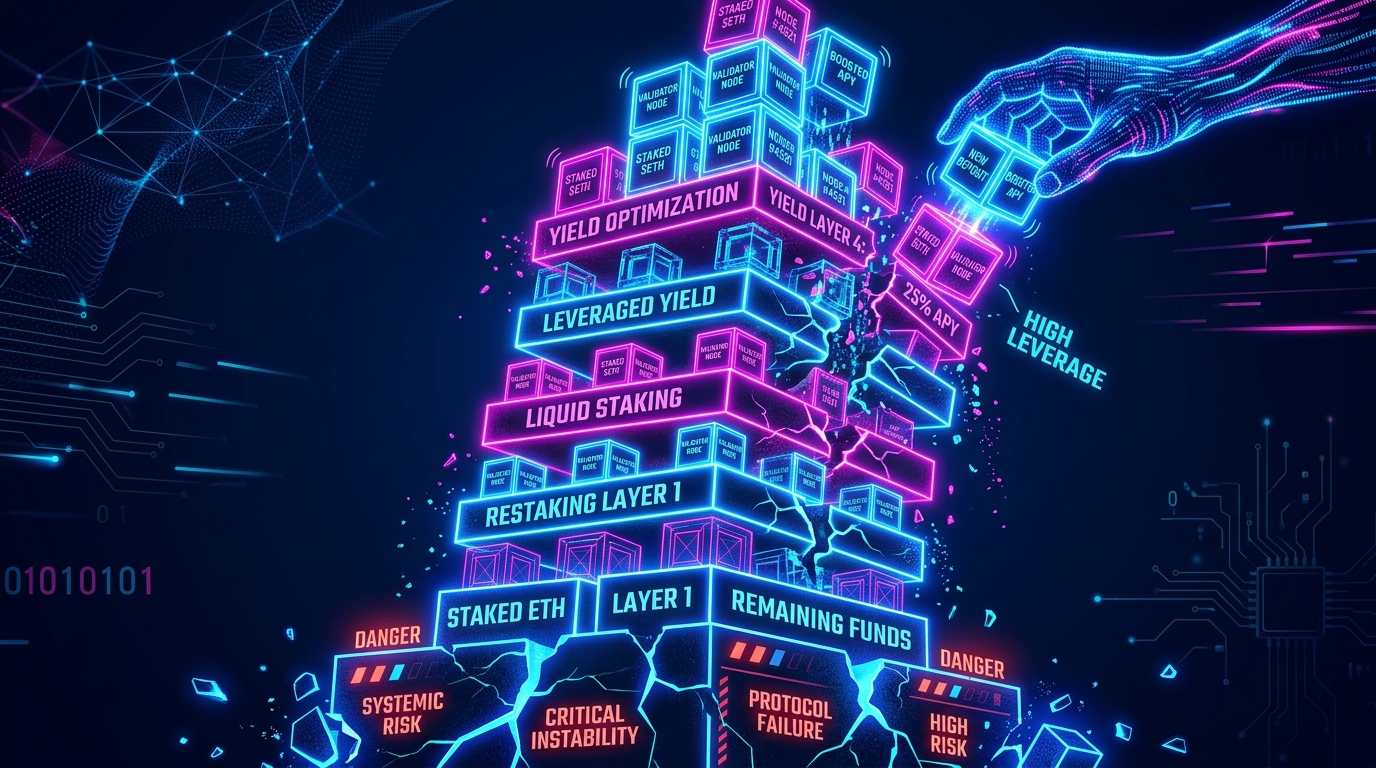
The core innovation of restaking lies in its ability to stack yields from disparate protocols onto a single underlying asset. A single Ether token might secure the base layer, a zero-knowledge rollup, an oracle network, and a decentralized sequencer simultaneously. The depositor earns fees from all four services. However, this hyper-efficiency creates a dense web of interlocking dependencies. The financial health of the base asset becomes inextricably linked to the operational integrity of numerous secondary protocols.
Market observers frequently compare this architecture to the collateralized debt obligations (CDOs) that catalyzed the 2008 global financial crisis. In both systems, yield generation relies on the complex tranching of underlying risk. The opacity of these interconnections makes holistic risk assessment exceedingly difficult. If a secondary protocol experiences a critical bug, the impact propagates instantly to the LRTs holding exposure, triggering valuation shocks across the lending markets that accept those LRTs as collateral.
Algorithmic trading models struggle to price these opaque risk vectors accurately. Traditional quantitative finance relies on historical correlation data to optimize portfolio construction. The restaking ecosystem lacks sufficient historical data to model severe stress events. Consequently, statistical arbitrage strategies operating in the LRT space often underestimate the probability of simultaneous, correlated defaults. Funds aggressively farming these stacked yields operate with significant unpriced tail risk.
Correlated Slashing and Liquidation Cascades
The most acute systemic threat in the restaking ecosystem involves correlated slashing events. Proof-of-stake networks enforce honest behavior by penalizing, or slashing, the capital of validators who break consensus rules. In a restaking paradigm, a single node operator validates multiple networks using the exact same collateral. If that operator suffers a massive technical failure or acts maliciously, the underlying collateral faces simultaneous slashing penalties from every protocol it secures.
A large-scale slashing event would trigger a catastrophic liquidation cascade across DeFi. If a major LRT loses a percentage of its backing due to slashing, its price on secondary markets will instantly decouple from its theoretical peg. Algorithmic liquidators constantly monitor lending protocols for undercollateralized positions. The price drop in the LRT would trigger automated liquidations, forcing the sale of the asset into thin order books and driving the price down further in a vicious feedback loop.
Quantitative risk managers actively map the slashing conditions of every protocol integrated into the EigenLayer ecosystem. By analyzing the smart contract code, they build probabilistic models of technical failure. Some hedge funds execute delta-neutral strategies by shorting specific LRTs against the base asset when their models indicate elevated slashing probabilities for the underlying node operators. These specialized trades provide a crucial price discovery mechanism for the true cost of risk in the restaking sector.
Assessing the Future of Delegated Security
The proliferation of restaking protocols forces the industry to confront the limits of capital efficiency. While the mechanism successfully boot-straps security for nascent networks, it fundamentally alters the risk profile of the Ethereum base layer. Regulators closely monitor the systemic implications of liquid restaking tokens, particularly their integration into regulated institutional portfolios. The SEC recently issued guidance regarding the classification of highly leveraged yield-bearing synthetic assets .
For the algorithmic trading community, restaking represents both a massive opportunity and a potential existential threat. The complexity of the ecosystem provides deep alpha for teams capable of parsing the interlocking smart contract risks. High-frequency arbitrageurs constantly extract value from the temporary peg deviations of various LRTs. Yet, the persistent threat of a correlated slashing event mandates extreme caution in position sizing.
The ultimate sustainability of restaking relies on the robust technical execution of the node operators. As the total value secured by these protocols continues to climb, the incentive for malicious exploits grows proportionally. The market structure of decentralized finance in 2026 relies heavily on the assumption that these complex systems can withstand severe volatility without fracturing the underlying collateral base.
Disclaimer: The information provided in this article is for educational and informational purposes only. It does not constitute financial, investment, or trading advice. Algorithmic trading and cryptocurrency investments carry significant risks, and past performance is not indicative of future results. Consult with a qualified financial advisor before making any investment decisions.