

TL;DR
- Privacy-First AI: Federated learning allows banks to train powerful machine learning models without ever moving or exposing sensitive customer data.
- Regulatory Compliance: This technology is critical for navigating strict global data privacy laws like GDPR while still fighting sophisticated financial fraud.
- Enterprise Adoption: Major deployments by Webank and utilizing frameworks like Nvidia FLARE are proving that federated learning is scalable in production environments.
In the highly regulated world of finance, data is both the most valuable asset and the greatest liability. Banks and financial institutions possess massive repositories of consumer behavior, transaction histories, and credit profiles - data that is essential for training robust machine learning models. However, strict data privacy laws and the existential threat of data breaches make sharing or centralizing this information nearly impossible. Enter federated learning: a breakthrough approach that is reshaping how the financial sector builds AI.
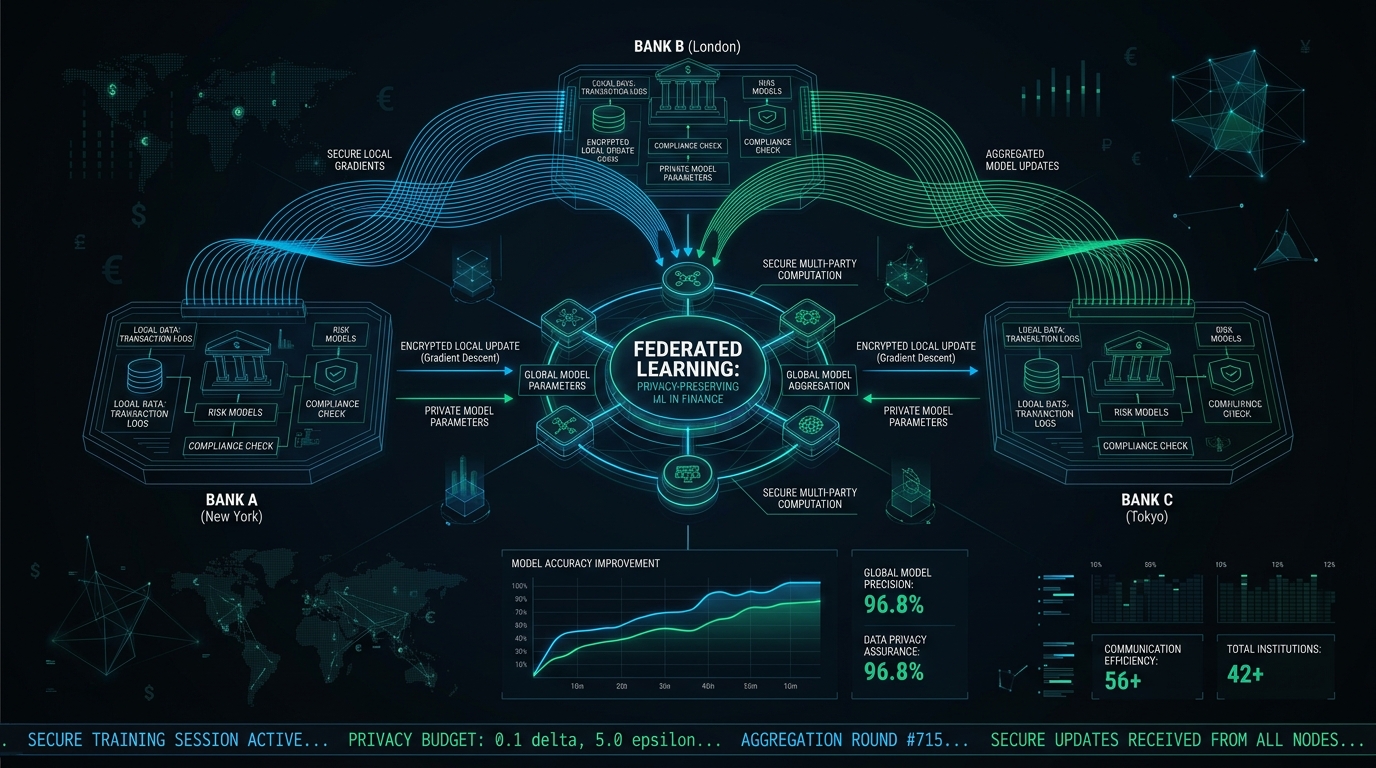
Federated learning is a decentralized machine learning technique where the algorithm is trained across multiple distinct devices or servers holding local data samples. Instead of pulling all the data into a central data lake - the traditional approach - the model itself is sent to where the data resides. The local nodes compute updates to the model and send only these mathematical adjustments back to a central server. The server aggregates these updates to improve the global model. At no point does raw, personally identifiable information (PII) ever leave its local environment.
Overcoming the Data Silo Challenge
For years, the inability to pool data across different branches, or especially between different financial institutions, has hindered the development of industry-wide fraud detection systems. Cybercriminals operate globally and fluidly across different banking networks, yet banks have been forced to fight them using only their localized, siloed data.
Federated learning provides a secure mechanism for "cross-silo" collaboration. Institutions can collectively train models that are far more accurate at identifying complex fraud rings or assessing credit risk for underbanked populations. Frameworks like Nvidia FLARE and Webank's FATE have become instrumental in deploying these collaborative networks. By participating in a federated learning consortium, a regional bank can benefit from the algorithmic insights generated by a global multinational, all while cryptographically guaranteeing that neither party exposes their underlying customer records.
| Feature | Centralized Machine Learning | Federated Learning |
|---|---|---|
| Data Storage | Aggregated in a central data lake | Remains strictly localized on client nodes |
| Privacy Risk | High; vulnerable to massive central breaches | Low; only model weights/updates are shared |
| Communication Cost | Low during training (data is local) | High; requires constant transmission of model updates |
| Regulatory Compliance | Difficult across borders (e.g., GDPR, CCPA) | Highly compatible with strict privacy regulations |
Technical Challenges and the Path Forward
While the privacy benefits are transformative, deploying federated learning in finance is not without significant technical hurdles. The most prominent challenge is communication overhead; transmitting complex model weights repeatedly across networks requires substantial bandwidth. Furthermore, data across different financial institutions is often non-IID (non-independent and identically distributed), meaning the statistical properties of the data vary wildly from one bank to another. This heterogeneity can make it difficult for the global model to converge smoothly.
Additionally, while raw data isn't shared, federated learning systems must defend against sophisticated "model inversion" attacks, where adversaries attempt to reverse-engineer private data from the shared model updates. To counter this, institutions are combining federated learning with Differential Privacy and Secure Multi-Party Computation (SMPC).
The Regulatory Perspective
Regulators are increasingly viewing federated learning not just as a compliance tool, but as a potential mandate for the future of collaborative AI in finance. As the industry integrates more advanced techniques, such as graph neural networks for fraud detection, the ability to execute these models securely via federated learning will be paramount. By decoupling data privacy from machine learning utility, federated learning is unlocking a new era of secure, collaborative innovation in the financial sector.
Disclaimer: This article is for informational purposes only. Implementation of machine learning models in financial systems should comply with all relevant local and international regulations.