
TL;DR
- Sub-Millisecond Execution: Modern institutional infrastructures rely on co-location and direct market access (DMA) to achieve execution latencies of under 100 microseconds, a critical threshold for high-frequency strategies.
- Data Processing Volume: Institutional systems process over 10 terabytes of market data daily, requiring robust distributed architectures to handle limit order book updates without bottlenecking signal generation.
- Risk Mitigation Priority: Following the Knight Capital incident, regulatory standards like SEC Rule 15c3-5 require rigorous pre-trade risk checks, adding mandatory computational overhead to all automated routing systems.
Related Insight: Time Series Foundation Models for Market Prediction
The Algorithmic Trading Stack
Building algorithmic trading infrastructure is less about finding a perfect alpha signal and more about constructing a resilient, deterministic, and highly available engineering stack. A minor bug or latency spike in the infrastructure can instantly neutralize the profitability of the best mathematical models. The modern trading stack is divided into highly specialized layers, each serving a critical function in the lifecycle of a trade.
At the top of the stack is the research and signal generation environment, typically heavily reliant on Python and data science frameworks. This layer crunches historical data to find predictive patterns. Once a signal is identified, it passes to the execution layer, which handles order routing, risk management, and venue connectivity. This lower layer must be hyper-optimized, usually written in C++ or Rust, and deployed as close to the exchange as physically possible.
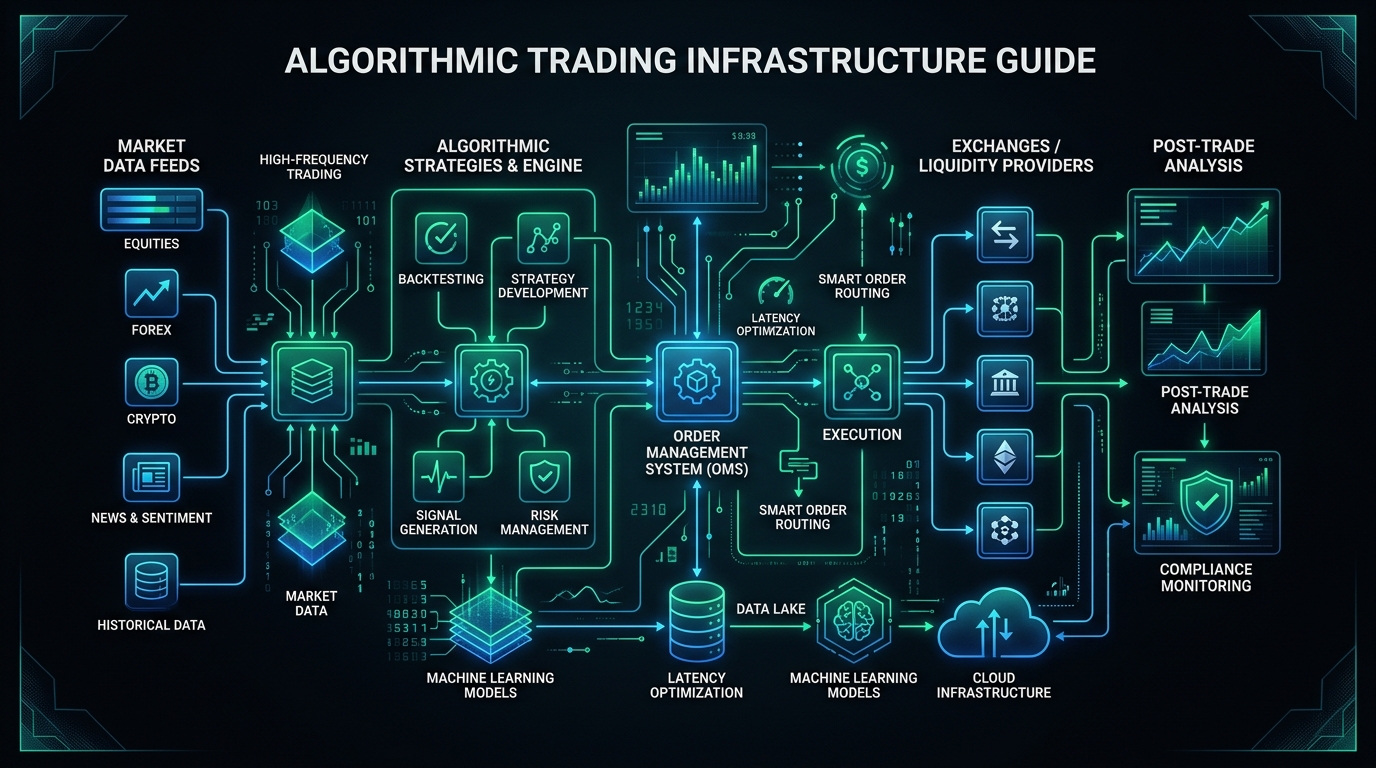
To visualize how these components interact, we can break down the stack into its primary functional modules.
graph TD
    A[Market Data Infrastructure] --> B(Signal Generation / Alpha)
    B --> C{Risk Management System}
    C -- Approved --> D[Order Management System]
    D --> E[Execution Management System]
    E --> F((Exchange Matching Engine))
    F -. Market Updates .-> A
    F -. Fill Confirmations .-> D
Market Data Infrastructure
Market data is the lifeblood of algorithmic trading. The infrastructure must handle a massive firehose of data - ticks, limit order book updates, and trade prints - with zero packet loss and absolute chronological precision. Firms typically subscribe to direct feeds from exchanges (like Nasdaq TotalView or NYSE OpenBook) or use aggregators for multi-asset coverage.
Latency is the primary concern in the data layer. In high-frequency trading (HFT), data is often processed using Field Programmable Gate Arrays (FPGAs) to parse network packets at the hardware level, bypassing the operating system entirely. For mid-frequency strategies, optimized C++ feed handlers process the data and publish it to an internal messaging bus, such as ZeroMQ or specialized low-latency middleware.
Choosing a market data vendor depends entirely on the strategy's time horizon. A long-short equity strategy rebalancing weekly can rely on delayed cloud-based APIs, while a statistical arbitrage strategy requires expensive, dedicated microwave links to transmit data between Chicago and New York milliseconds faster than fiber optic cables.
Signal Generation and Backtesting Frameworks
The signal generation layer is where the "alpha" resides. This environment takes normalized market data and feeds it into mathematical models to generate trading decisions. As machine learning becomes more prevalent, this layer increasingly involves complex neural networks. For example, integrating Transformer Models in Financial Forecasting requires significant GPU compute resources, which must be seamlessly integrated into the production pipeline.
Before a signal is ever deployed live, it must be validated through rigorous backtesting. An institutional backtester must accurately simulate slippage, market impact, latency delays, and historical order book states. If a backtest assumes it can instantly cross the spread without moving the market, its results are effectively worthless.
Platforms like QuantConnect provide robust cloud-based environments for research and backtesting, offering an open-source LEAN engine that mirrors live trading constraints. However, many quantitative hedge funds choose to build proprietary backtesters to ensure they have absolute control over the simulation physics and to protect their intellectual property. Furthermore, implementing Reinforcement Learning Trading Strategies often requires custom simulation environments that interact dynamically with the agent.
Risk Management: The Most Critical Layer
In algorithmic trading, risk management is not just a regulatory requirement; it is a matter of survival. The system must possess the ability to instantly kill any strategy or disconnect from the exchange if anomalous behavior is detected. This involves both pre-trade risk checks (verifying capital limits, maximum order sizes, and price fat-finger checks) and post-trade exposure monitoring (calculating Value at Risk (VaR) and portfolio drawdowns).
The catastrophic potential of inadequate risk infrastructure was permanently etched into Wall Street history by the Knight Capital Group incident in 2012. Due to a deployment error, obsolete test code was activated in a production environment, causing the firm's algorithms to execute millions of unintended trades. In just 45 minutes, Knight Capital accumulated over $460 million in losses, essentially destroying the firm. The SEC's subsequent administrative proceeding resulted in a hefty fine and cemented the enforcement of the "Market Access Rule" (Rule 15c3-5), mandating strict, automated pre-trade controls.
Modern risk layers operate entirely independently of the signal generation logic. If an algorithm attempts to buy 10,000 shares of Apple but its daily limit is 1,000, the risk layer intercepts the order and rejects it before it ever reaches the network interface card. This deterministic safety net is the only thing standing between an automated strategy and institutional bankruptcy.
Order Management & Execution
Once an order passes the risk checks, it moves to the Order Management System (OMS) and the Execution Management System (EMS). The OMS is the bookkeeper; it tracks the overall portfolio state, the lifecycle of active orders, and P&L. The EMS is the tactical operator; it is responsible for taking a large "parent" order from the OMS and slicing it into smaller "child" orders to minimize market impact.
The EMS often incorporates Smart Order Routing (SOR) logic. Since modern equity markets are fragmented across dozens of exchanges and dark pools, the SOR algorithm must determine the optimal venue to route the child order based on historical liquidity, fee structures, and current order book depth.
Execution performance is continuously monitored via Transaction Cost Analysis (TCA). TCA models compare the actual execution price against benchmarks (like the Volume Weighted Average Price, or VWAP, over the order duration) to measure slippage. If the EMS consistently underperforms the benchmark, the execution logic must be retuned.
Post-Trade Analytics
The algorithmic trading loop does not end when the market closes. Post-trade analytics infrastructure ingests the massive logs generated throughout the day to evaluate system performance and strategy drift. This involves reconciling executed trades with clearing firms, updating historical datasets, and calculating precise attribution of P&L.
Data warehousing plays a crucial role here. Billions of rows of log data are stored in column-oriented databases like ClickHouse or kdb+ for ultra-fast querying. Quantitative researchers analyze these logs to see exactly what the market state was microsecond by microsecond when an order was placed, allowing them to refine their execution models and identify subtle latency bottlenecks in the network stack.
This feedback loop ensures that the infrastructure evolves alongside the market. A strategy that is profitable in a low-volatility environment might suddenly begin experiencing severe slippage during a market shock, and the post-trade analytics platform is what alerts the researchers to this degradation before it erodes capital.
The Build vs. Buy Decision
Firms must decide whether to build their infrastructure from scratch or buy off-the-shelf components. The decision hinges on the firm's primary source of edge. If the alpha relies on complex statistical modeling over days or weeks, buying an institutional OMS/EMS makes sense. If the edge relies on microsecond latency arbitrage, building proprietary low-level C++ infrastructure is mandatory.
| Feature | QuantConnect / LEAN | Alpaca API | Interactive Brokers (API) | Bloomberg EMSX |
|---|---|---|---|---|
| Target Audience | Retail / Boutique Quants | Retail / Startups | Prosumer / Small Funds | Institutional / Hedge Funds |
| Primary Strength | Cloud Backtesting & Data | Simple REST API, Crypto/Equities | Deep Asset Class Coverage | Institutional Connectivity & Routing |
| Hosting Model | Cloud or Local CLI | Cloud API | Local Gateway Software | Managed / Terminal Integrated |
| Cost Profile | Low (Open Source base) | Low (Commission-free options) | Medium (Data & API fees) | High (Terminal licenses + FIX fees) |
Getting Started: A Python-Based Setup
For developers entering the space, the barrier to entry has never been lower. You do not need microwave towers to start building algorithmic infrastructure. A robust, modern setup can be built entirely in Python using modern APIs.
A standard architecture for a retail quant or startup fund involves using Python with the pandas and scikit-learn libraries for research and signal generation. Data is pulled via REST API from providers like Alpaca or Polygon.io. For backtesting, open-source frameworks like Backtrader or Zipline (or QuantConnect's LEAN engine run locally) simulate the strategy performance.
Once a strategy is validated, the production deployment typically involves packaging the Python code into a Docker container and deploying it on a reliable cloud provider (AWS, GCP). The live algorithm listens to a WebSocket stream for real-time market data, processes the signal, and sends execution requests via REST API to modern, developer-friendly brokerages like Alpaca or Interactive Brokers. This architecture provides a scalable, professional foundation that can be incrementally upgraded as the strategy's AUM grows.
Disclaimer: This article is for informational purposes only and does not constitute financial or investment advice. Always consult with a qualified professional before making any investment decisions.