
TL;DR
- Enterprise edge computing solutions are seeing a major demand surge in 2026, driven by real-time processing requirements.
- Algorithmic trading firms are deploying edge nodes to process alternative data streams locally, bypassing slow cloud networks.
- Capital expenditure in edge infrastructure is projected to hit record highs this fiscal year, reshaping fintech hardware budgets.
The Microsecond Arbitrage of Distributed Hardware
The deployment of enterprise edge computing solutions has reached an inflection point in July 2026, driven by the relentless market demand for localized, real-time data processing. For financial institutions and quantitative trading funds, this structural shift marks a migration away from centralized cloud architectures toward distributed micro-datacenters. The ability to ingest, filter, and analyze vast datasets at the point of origin has transformed the mechanics of market execution.
In quantitative finance, latency remains the ultimate arbiter of profitability. While traditional colocation placed trading servers inside exchange datacenters, the rise of alternative data requires a broader footprint. By processing raw data where it is generated, trading algorithms can bypass the latency bottleneck of transferring raw files across transcontinental fiber networks.
This model of distributed processing allows market participants to extract proprietary signals before the broader market even registers the underlying event. The physics of light transmission through glass fiber limits speed over distance, making physical proximity to the data source an absolute necessity. Consequently, edge computing has evolved from a remote industrial tool into a core instrument of financial arbitrage.
Decentralizing Alternative Data Ingestion
The integration of alternative data (ranging from maritime transponders to agricultural sensors) has historically been limited by bandwidth. A single cargo port can generate terabytes of raw video and sensor data daily, making continuous cloud uploads cost-prohibitive and slow. Enterprise edge computing solutions solve this by running localized machine learning models directly on ruggedized edge gateways located at the port.
Instead of transmitting high-definition video feeds, the edge node processes the footage locally and transmits a highly compressed, structured data packet. A quant firm receives a simple message stating that container throughput at a specific berth has dropped by 15 percent. This local intelligence enables trading algorithms to adjust commodity and shipping equity positions hours before public reports are updated.
[Alternative Data Source] -> [Localized Edge Node (AI Filtering)] -> [Compressed Signal Only] -> [Trading Server]
This decentralized processing architecture is particularly vital for agricultural trading. Soil moisture sensors, localized weather stations, and drone imagery are aggregated at regional rural offices. The local node calculates crop yield projections dynamically, broadcasting micro-signals directly to proprietary trading desks.
Hardware Anchors of the Edge Revolution
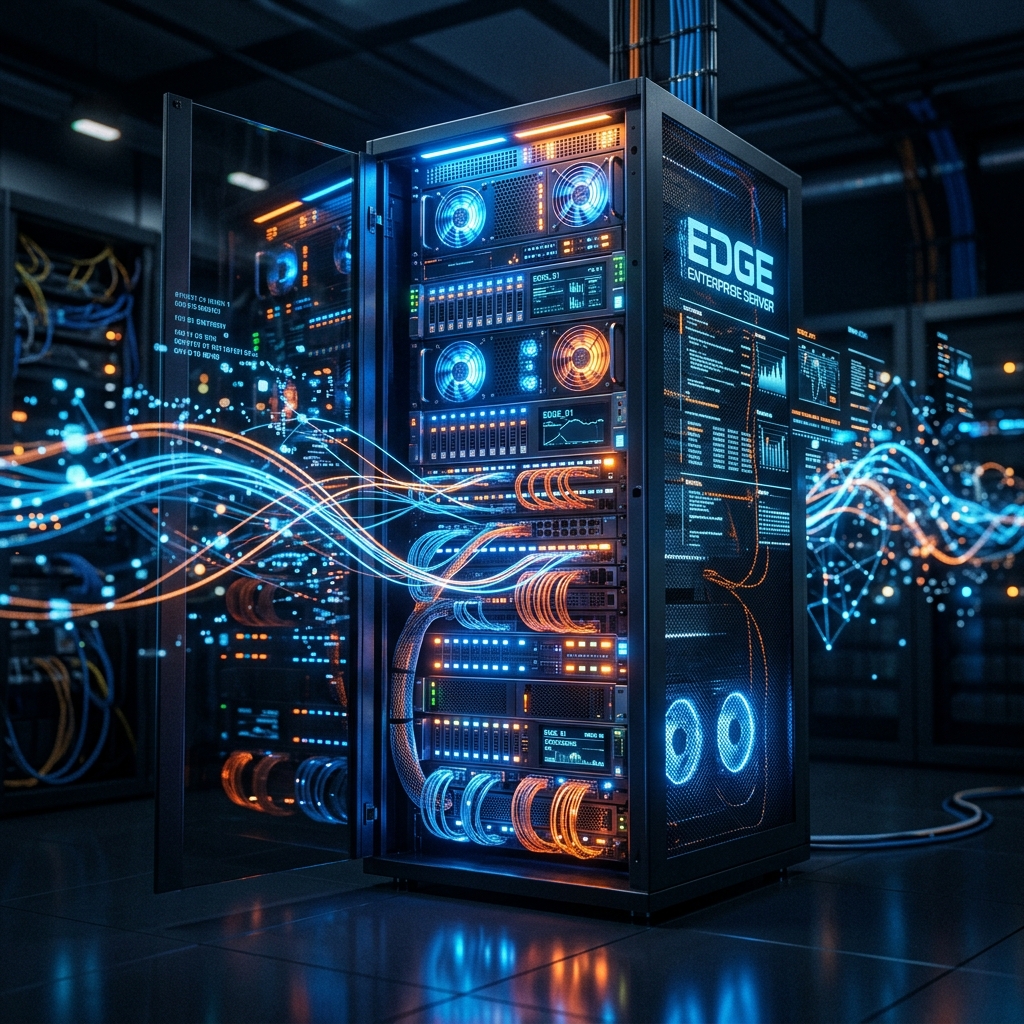
The physical deployment of edge architecture relies on specialized silicon and infrastructure. Companies like Nvidia, Dell Technologies, and Hewlett Packard Enterprise have developed highly specialized edge servers capable of operating in harsh environments without dedicated cooling. According to a July 2026 report by Gartner, global enterprise spending on edge hardware grew by 24 percent year-over-year ``.
These systems utilize advanced Field Programmable Gate Arrays (FPGAs) and application-specific integrated circuits (ASICs) tailored for low-power, high-throughput mathematical operations. By running compressed quantitative trading models directly on these chips, processing delays are reduced to the single-digit microsecond range.
+-------------------------------------------------------------+
|                     Edge Server Node                        |
|  +--------------------+             +--------------------+  |
|  |   FPGA/ASIC Array  |  -------->  | Low-Power AI Model |  |
|  | (Raw Signal Input) |             | (Signal Extraction)|  |
|  +--------------------+             +--------------------+  |
+-------------------------------------------------------------+
                               |
                               v
                     [Structured Data Out]
Furthermore, telecommunications providers are actively monetizing their 5G and early 6G cellular towers by hosting micro-datacenters. Algorithmic trading firms are leasing space on these towers to position computation engines closer to physical retail centers, industrial parks, and transport hubs. This integration of telecom infrastructure and financial compute represents a multi-billion-dollar convergence of industries.
Implementing Edge Architecture in High-Frequency Systems
Integrating edge computing into high-frequency trading networks requires a fundamental redesign of software pipelines. Traditional monolithic quantitative trading models must be decomposed into lightweight, distributed micro-services. These micro-services execute simple, deterministic filtering tasks at the edge while the complex portfolio optimization algorithms remain in centralized exchange datacenters.
This methodology relies heavily on advanced NLP in trading techniques optimized for edge hardware. Local natural language engines process regional news broadcasts, local emergency scanner feeds, and municipality announcements at the municipal level. By extracting sentiment metrics at the source, the local node transmits structured sentiment vectors to central execution algorithms, bypassing the delays of standard news aggregators.
Security remains a primary concern when deploying intellectual property to remote hardware. Because edge nodes are physically dispersed, they are inherently more vulnerable to tampering than centralized bank vaults. Quantitative firms utilize secure enclaves and cryptographic trust modules to ensure that their proprietary signal-generation algorithms cannot be reverse-engineered if a physical node is compromised.
Capitalizing on the Edge Computing Infrastructure Shift
As enterprise edge computing solutions gain market share, the investment thesis for technology-focused portfolios is shifting. The primary beneficiaries are not the traditional hyper-scale cloud providers, but rather the specialized chipmakers and infrastructure developers who build the physical foundation of the edge. Companies providing low-power semiconductor designs and remote management software are positioned to capture high-margin revenue streams.
According to research by the International Data Corporation (IDC), regional deployments of enterprise edge nodes will surpass 40 million units annually by the end of 2026 ``. For active managers, this trend highlights opportunities in specialized real estate investment trusts (REITs) that focus on cellular tower hosting and edge data facilities.
To understand how these physical infrastructure changes interact with digital execution and decentralized networks, explore our ongoing analyses of modern quantitative trading models and the latest developments in secure decentralized consensus protocols. The integration of high-performance localized hardware with global execution platforms will define the next decade of market efficiency.
Disclaimer: This article is for informational purposes only and does not constitute financial advice. Always consult a qualified financial advisor before making investment decisions.