

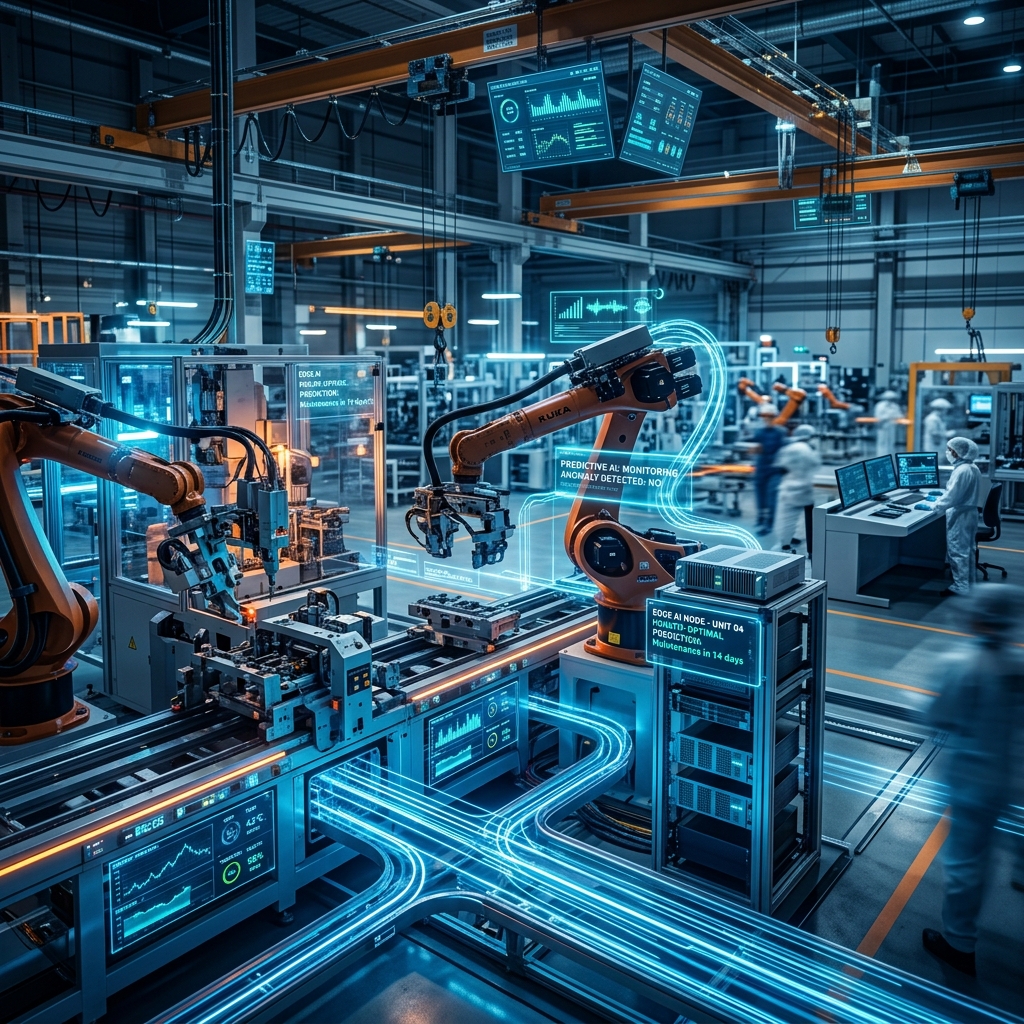
The Role of AI in Predictive Maintenance for Edge Computing
In today's fast-paced digital and industrial landscapes, unexpected equipment failure is more than just an inconvenience - it's a massive financial drain. As organizations increasingly deploy infrastructure closer to where data is generated, edge computing has become a critical component of modern IT architecture. But managing distributed assets at the edge introduces unique challenges. Enter Artificial Intelligence (AI) and predictive maintenance, a powerful combination that is transforming how industries prevent outages and reduce downtime.
What is Edge Computing?
Edge computing brings computation and data storage closer to the location where it is needed, improving response times and saving bandwidth. Instead of sending all data to a centralized cloud for processing, edge devices process information locally. This is essential for latency-sensitive applications like autonomous vehicles, smart factories, and remote energy grids.
The Challenge of Maintenance at the Edge
Traditional maintenance strategies typically fall into two categories:
- Reactive Maintenance: Fixing equipment after it breaks. This leads to costly, unplanned downtime.
- Preventative Maintenance: Performing routine checks on a set schedule. While better, this often results in unnecessary maintenance, replacing parts that still have remaining useful life.
When dealing with edge computing, where devices are geographically dispersed and sometimes located in harsh or remote environments, both of these approaches are highly inefficient. Sending technicians to investigate every minor anomaly is prohibitively expensive, and waiting for a critical failure can halt entire operations.
How AI Powers Predictive Maintenance at the Edge
Predictive maintenance leverages data analysis to anticipate equipment failures before they happen. By integrating AI at the edge, organizations can shift from a reactive to a proactive operational model.
1. Real-Time Data Processing and Analytics
Edge devices are equipped with sensors that continuously monitor parameters such as temperature, vibration, acoustics, and power consumption. AI algorithms process this massive influx of sensor data locally, in real-time. Because the AI is running at the edge, there is no need to wait for data to travel to the cloud and back, allowing for instantaneous anomaly detection.
2. Machine Learning for Anomaly Detection
Machine learning (ML) models are trained on historical data to understand the normal operating conditions of a machine. Once deployed at the edge, these models continuously compare real-time sensor data against their baseline. If the AI detects a subtle deviation - such as a microscopic change in a motor's vibration - it can predict a potential failure and alert operators days or even weeks in advance.
Key Benefits of AI-Driven Predictive Maintenance
The integration of AI into edge computing for predictive maintenance offers several game-changing advantages:
- Dramatically Reduced Downtime: By identifying failing components before they break, organizations can schedule maintenance during planned outage windows, ensuring continuous operations.
- Significant Cost Savings: Predictive maintenance eliminates the costs associated with emergency repairs, overtime labor, and lost production time. It also maximizes the lifespan of equipment by ensuring parts are only replaced when genuinely necessary.
- Reduced Cloud Dependency and Bandwidth Costs: Processing data at the edge means only critical alerts and summaries need to be sent to the central cloud, drastically reducing data transmission and storage costs.
- Improved Safety: In industrial settings, unexpected equipment failures can pose severe safety risks to workers. Predicting these failures mitigates potential hazards.
Real-World Applications
- Manufacturing (Smart Factories): Industrial IoT (IIoT) relies heavily on edge computing. AI models monitor robotics and assembly line machinery, predicting wear and tear on drill bits, motors, and conveyor belts to prevent manufacturing bottlenecks.
- Energy and Utilities: Wind turbines and remote solar farms use edge AI to monitor gearbox health, blade integrity, and panel efficiency. Maintenance crews are only dispatched when an AI alert indicates a specific component requires attention.
- Telecommunications: 5G cell towers and edge data centers utilize AI to monitor cooling systems, power supplies, and server health, ensuring uninterrupted connectivity for millions of users.
Conclusion
As the footprint of edge computing continues to expand, managing this distributed infrastructure requires intelligent, scalable solutions. AI-powered predictive maintenance is no longer a futuristic concept - it is a necessary evolution. By processing data locally and predicting failures before they occur, AI at the edge empowers organizations to reduce downtime, cut costs, and optimize their operations for the future.