

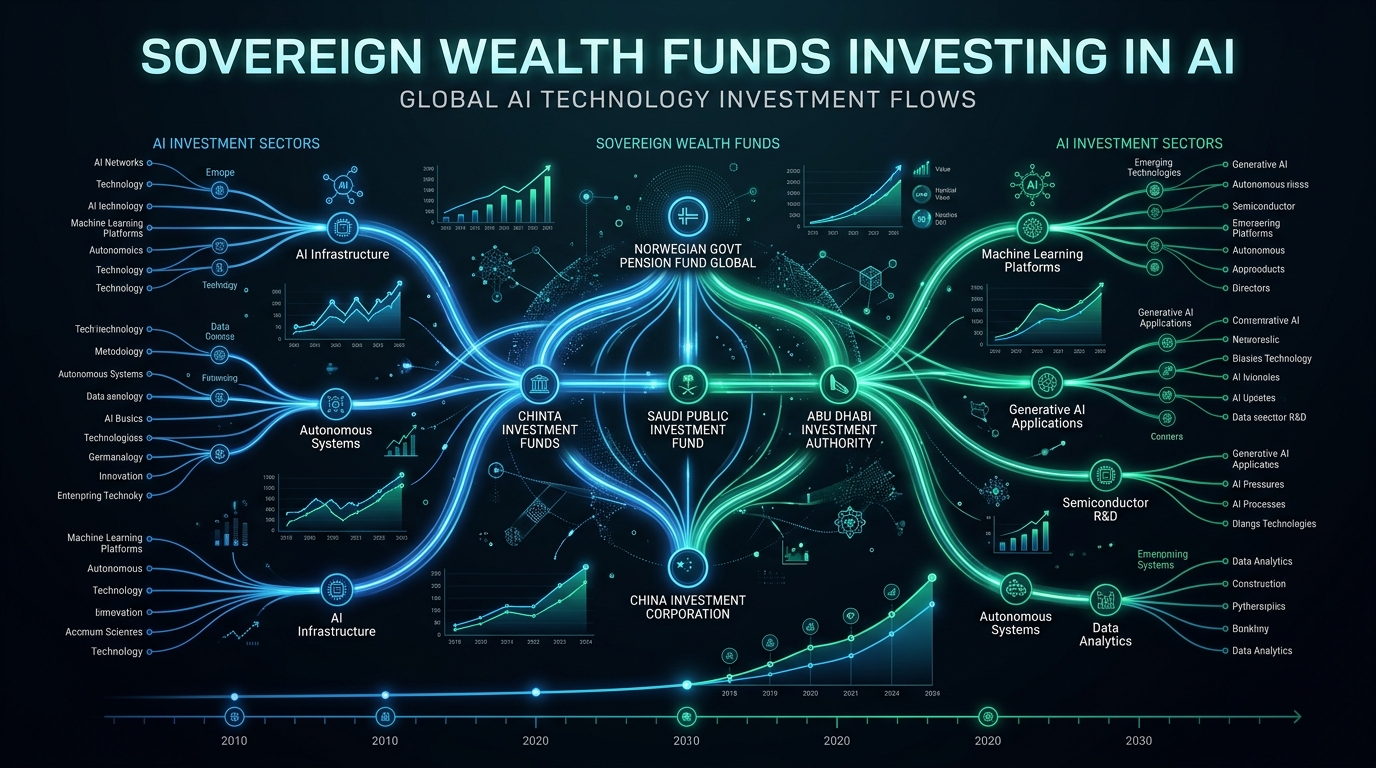
TL;DR
- Massive Capital Deployment: Sovereign Wealth Funds (SWFs) like Norway's NBIM and Singapore's GIC have rapidly increased their allocation to AI and tech, driving tens of billions into foundational infrastructure and enablers.
- Operational Transformation: Beyond passive investing, funds are becoming "AI-native." NBIM reports saving over 213,000 hours annually by integrating AI into their internal investment and risk monitoring workflows.
- Geopolitical Strategy: Middle Eastern funds (ADIA, PIF) are utilizing AI investments as a strategic lever to diversify away from fossil fuels, occasionally triggering complex geopolitical negotiations over semiconductor access.
The Structural Shift in Sovereign Capital
Sovereign Wealth Funds (SWFs), managing trillions in state-owned capital, have traditionally been characterized by their conservative, long-term asset allocation models. However, the artificial intelligence revolution has prompted a structural . No longer content with merely holding passive stakes in mega-cap technology equities, these institutional behemoths are now aggressively deploying capital across the entire AI value chain - from semiconductor foundries and specialized data centers to foundational model developers and energy infrastructure.
This aggressive reallocation is driven by the realization that AI represents a general-purpose technology comparable to the advent of electricity or the internet. Funds like the Abu Dhabi Investment Authority (ADIA), Singapore’s GIC, and Norway’s Norges Bank Investment Management (NBIM) have independently concluded that failing to adequately capture the upside of AI infrastructure equates to a dereliction of fiduciary duty. Consequently, tech and AI allocations within alternative and private market portfolios have swelled dramatically in 2025 and 2026.
The implications for global asset valuations are profound. When price-insensitive, long-duration capital targets a specific sector, it compresses risk premiums and artificially sustains high valuation multiples. The influx of SWF capital into AI "enablers" - the companies building the physical and digital infrastructure necessary for AI training and inference - has provided a massive liquidity backstop for the sector, insulating it somewhat from broader macroeconomic tightening cycles.
Strategic Frameworks: Enablers, Monetisers, and Adopters
Analyzing the annual reports of major SWFs reveals a sophisticated, multi-tiered approach to AI exposure. Singapore’s GIC, for instance, explicitly segments its AI investment universe into three distinct categories to manage risk and capture value across the maturity curve. The first category, Enablers, encompasses the foundational layer: semiconductor manufacturers (Nvidia, TSMC), specialized data center operators (Vantage Data Centres), and critical energy infrastructure providers. This is where the bulk of private capital has been directed, given the tangible nature of the assets and the predictability of hyperscaler demand.
The second category, Monetisers, involves businesses building AI-powered products, platforms, and foundational models (such as OpenAI, Anthropic, and Databricks). SWFs approach this tier with a blend of venture capital agility and institutional scale, often participating in massive late-stage funding rounds. The final category, Adopters, focuses on traditional enterprises across healthcare (Eli Lilly), finance, and logistics that are successfully integrating AI to transform their operations, thereby achieving margin expansion and competitive moats.
Norway’s NBIM, which manages the Government Pension Fund Global, takes a similarly robust but slightly different approach, given its mandate as a largely public equities investor. Under the leadership of CEO Nicolai Tangen, NBIM has explicitly adopted an "all-in on AI" mandate (Strategy 28). This strategy not only dictates their external portfolio positioning but fundamentally alters their internal operations. NBIM relies on AI models to anticipate changes in its benchmark indices, reduce unnecessary trading costs, and screen thousands of companies for ESG risks, saving an estimated 213,000 human-hours annually.
Sovereign Wealth Fund AI Exposure
| Fund Name | Country | Est. Total AUM | Key AI/Tech Allocation Focus | Notable Recent Investments / Initiatives |
|---|---|---|---|---|
| NBIM | Norway | $1.6 Trillion | Public Equities, AI Adopters, Internal AI | Heavy overweight in 'Magnificent 7'; Internal "Strategy 28" AI integration |
| GIC | Singapore | $770 Billion | Infrastructure, Enablers, Monetisers | Vantage Data Centres, Anthropic, Enterprise AI Platform rollout |
| ADIA | UAE | $990 Billion | Private Equity, Compute Infrastructure | Large-scale data center joint ventures, specialized AI venture funds |
| PIF | Saudi Arabia | $925 Billion | Foundational Models, Tech Sovereignty | Multi-billion dollar tech fund initiatives, local semiconductor push |
The Geopolitical Dimension of AI Investments
The aggressive deployment of sovereign capital into AI cannot be viewed in a purely financial vacuum; it is deeply intertwined with global geopolitics. For nations in the Middle East, such as Saudi Arabia (via the PIF) and the United Arab Emirates (via ADIA and Mubadala), AI investments are a critical component of their post-oil economic diversification strategies. These nations are vying to become global AI hubs, investing heavily in domestic supercomputing capacity and sovereign AI models.
However, this ambition occasionally collides with US national security interests. The implementation of export controls on advanced semiconductors (like Nvidia's H100 and B200 chips) to certain regions has forced sovereign wealth funds to navigate complex diplomatic negotiations. To secure hardware access, these funds are increasingly structuring their investments to align with US strategic interests, sometimes divesting from Chinese tech entities or agreeing to strict data governance frameworks overseen by Western regulators.
As we look toward the macroeconomic landscape of late 2026, the concentration of SWF capital in AI infrastructure serves as both a catalyst for unprecedented technological acceleration and a potential systemic risk. For insights on how central bank policies are affecting broader asset classes in this environment, review our analysis on the Fed Rate Path 2026 and Bond Market Implications. Ultimately, the sovereign funds that correctly identify the enduring winners in the AI infrastructure buildout will secure outsized returns for generations.
Disclaimer: This article is for informational purposes only and does not constitute financial, investment, or legal advice. Institutional asset allocation is subject to complex macroeconomic risks. Consult with a qualified professional before making any investment decisions.