

TL;DR
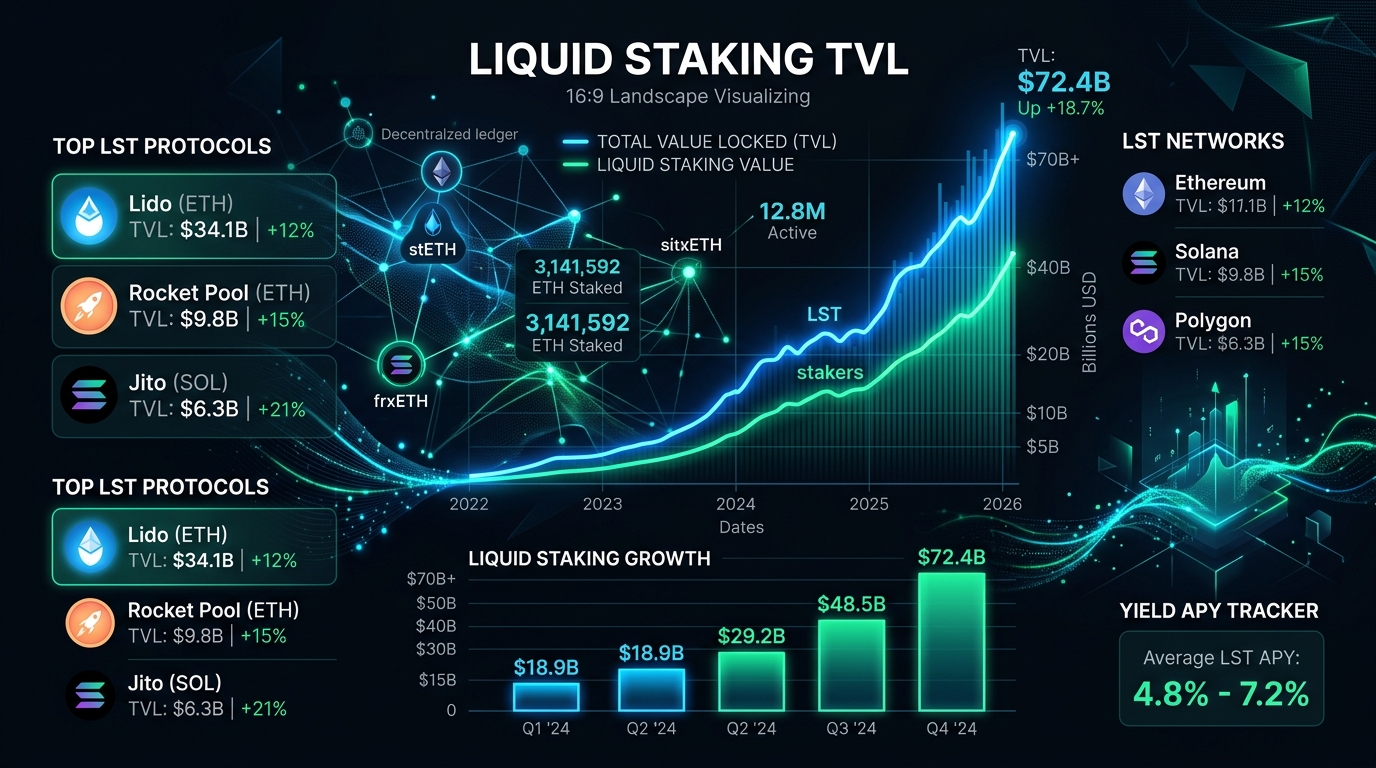
- $120 Billion Milestone: The Total Value Locked (TVL) across decentralized finance platforms has surged past $120 billion in 2026, marking a robust recovery driven largely by institutional capital.
- Liquid Staking Dominance: Protocols like Lido and Rocket Pool account for a disproportionate share of the TVL growth, as investors seek to maximize yield while maintaining asset liquidity.
- The Restaking Multiplier: EigenLayer and the emergence of Liquid Restaking Tokens (LRTs) have catalyzed a secondary boom, creating complex yield strategies but also introducing new layers of systemic risk.
Analyzing the DeFiLlama TVL Data Breakdown
The decentralized finance (DeFi) ecosystem has experienced a dramatic resurgence in 2026. According to data aggregated by DeFiLlama, the Total Value Locked (TVL) across all tracked blockchains has confidently crossed the $120 billion threshold. This figure represents more than just a recovery from previous bear markets; it signals a maturation of the space. While early DeFi cycles were characterized by speculative yield farming and ephemeral protocols, the current growth is underpinned by infrastructure projects and sustainable yield models that are attracting serious, long-term capital.
the DeFiLlama metrics reveals that this growth is not evenly distributed. A significant concentration of capital is flowing directly into liquid staking and restaking protocols on the Ethereum network. Traditional lending markets and decentralized exchanges (DEXs) are seeing steady, organic growth, but they are being outpaced by protocols that offer base-layer yields. This trend highlights a shift in investor preference towards "risk-free" native crypto yields, which serve as the benchmark rate for the entire decentralized economy.
Furthermore, analyzing the protocol revenue versus TVL ratio exposes the financial realities of this boom. While TVL is an excellent metric for measuring adoption and trust, it does not always correlate directly with protocol profitability. Some platforms boast billions in TVL but generate minimal revenue for token holders, relying heavily on token emissions to incentivize deposits. In contrast, top-tier liquid staking protocols operate highly efficient models where revenue scales linearly with TVL, cementing their position as the blue-chip assets of the new digital economy.
The Liquid Staking and Restaking Meta
The undeniable engine behind this TVL surge is the liquid staking sector. Protocols like Lido Finance and Rocket Pool have solved a fundamental capital inefficiency in Proof-of-Stake networks. By issuing derivative tokens (such as stETH or rETH) backed 1:1 by staked Ethereum, these platforms allow investors to earn network validation rewards without locking up their capital. These Liquid Staking Tokens (LSTs) have become the de facto collateral of DeFi, deeply integrated into money markets and derivative platforms, thereby amplifying their utility and driving further deposits.
Building upon this foundation, 2026 has been defined by the explosion of "restaking," pioneered by EigenLayer. EigenLayer allows users to repurpose their staked ETH or LSTs to secure other decentralized applications and networks, earning additional yield in the process. This has spawned a new derivative class: Liquid Restaking Tokens (LRTs). LRT protocols pool user deposits, manage the complex restaking strategies on EigenLayer, and issue a liquid receipt token. This layered approach has created a highly lucrative, albeit complex, yield environment that has captured billions in TVL in a matter of months.
Accompanying the rise of LRTs is the controversial "points meta." To bootstrap liquidity before launching a native token, many restaking protocols implement points systems that reward users for deposits and engagement. These points act as a speculative IOU for future airdrops, driving a frenzy of capital rotation as users attempt to maximize their potential rewards. While highly effective for short-term growth, this dynamic creates highly mercenary liquidity that can vanish as quickly as it arrives once the underlying tokens are finally distributed. For a comparison of these yields against traditional markets, see our analysis on Ethereum Staking Yields vs Traditional Finance.
Understanding the Compounding Risks
While the surging TVL paints a picture of a thriving ecosystem, the layered nature of liquid staking and restaking introduces significant, compounding risks. The most immediate concern is the depeg risk. While tokens like stETH or various LRTs are designed to trade at parity with ETH, secondary market dynamics during periods of extreme volatility or liquidity crunches can cause them to trade at a discount. A significant depeg could trigger a cascade of liquidations across lending protocols that accept these tokens as collateral, precipitating a broader market panic.
Smart contract risk is another critical factor that is often underestimated in periods of rapid growth. A traditional DeFi protocol carries the risk of a vulnerability in its own code. However, a liquid restaking protocol builds upon the code of a liquid staking protocol (like Lido), which in turn relies on the underlying consensus mechanism of Ethereum, while simultaneously interacting with the complex smart contracts of EigenLayer. A bug at any layer of this intricate stack can compromise the entire structure, resulting in a catastrophic loss of funds for users.
Finally, the immense success of a few key players has led to unprecedented centralization risks. Lido, for example, commands a massive share of all staked Ethereum. If a single entity or a cartel of node operators controls a significant portion of network validation, it threatens the fundamental decentralization and security assumptions of the blockchain. Regulators and core developers are increasingly concerned about this concentration, prompting discussions about protocol-level limits to ensure the long-term resilience of the network amidst this TVL boom.
Top 10 DeFi Protocols by TVL (Q3 2026 Estimate)
| Rank | Protocol | Category | TVL (Billions USD) | Dominance (%) |
|---|---|---|---|---|
| 1 | Lido Finance | Liquid Staking | $34.5 | 28.7% |
| 2 | EigenLayer | Restaking | $18.2 | 15.1% |
| 3 | Aave | Lending | $11.4 | 9.5% |
| 4 | MakerDAO | CDP/Stablecoin | $8.9 | 7.4% |
| 5 | Uniswap | DEX | $6.2 | 5.1% |
| 6 | Rocket Pool | Liquid Staking | $4.8 | 4.0% |
| 7 | Curve Finance | DEX | $3.7 | 3.0% |
| 8 | ether.fi | Liquid Restaking | $3.5 | 2.9% |
| 9 | Compound | Lending | $2.9 | 2.4% |
| 10 | Synthetix | Derivatives | $2.1 | 1.7% |
Disclaimer: This article is for informational purposes only and does not constitute financial, legal, or investment advice. Always consult with a qualified professional before making investment decisions.