
TL;DR
- The dominance of legacy x86 processors in the data center is rapidly eroding as highly efficient ARM architectures gain massive market share.
- Major cloud providers are aggressively deploying custom silicon, fundamentally altering the revenue models of traditional semiconductor manufacturers.
- Algorithmic trading desks analyze workload-specific benchmarks to predict shifts in capital expenditure across the hyperscale cloud market.
- Total cost of ownership metrics heavily favor ARM deployments for specific web serving and database applications, accelerating enterprise adoption.
The Architectural Paradigm Shift
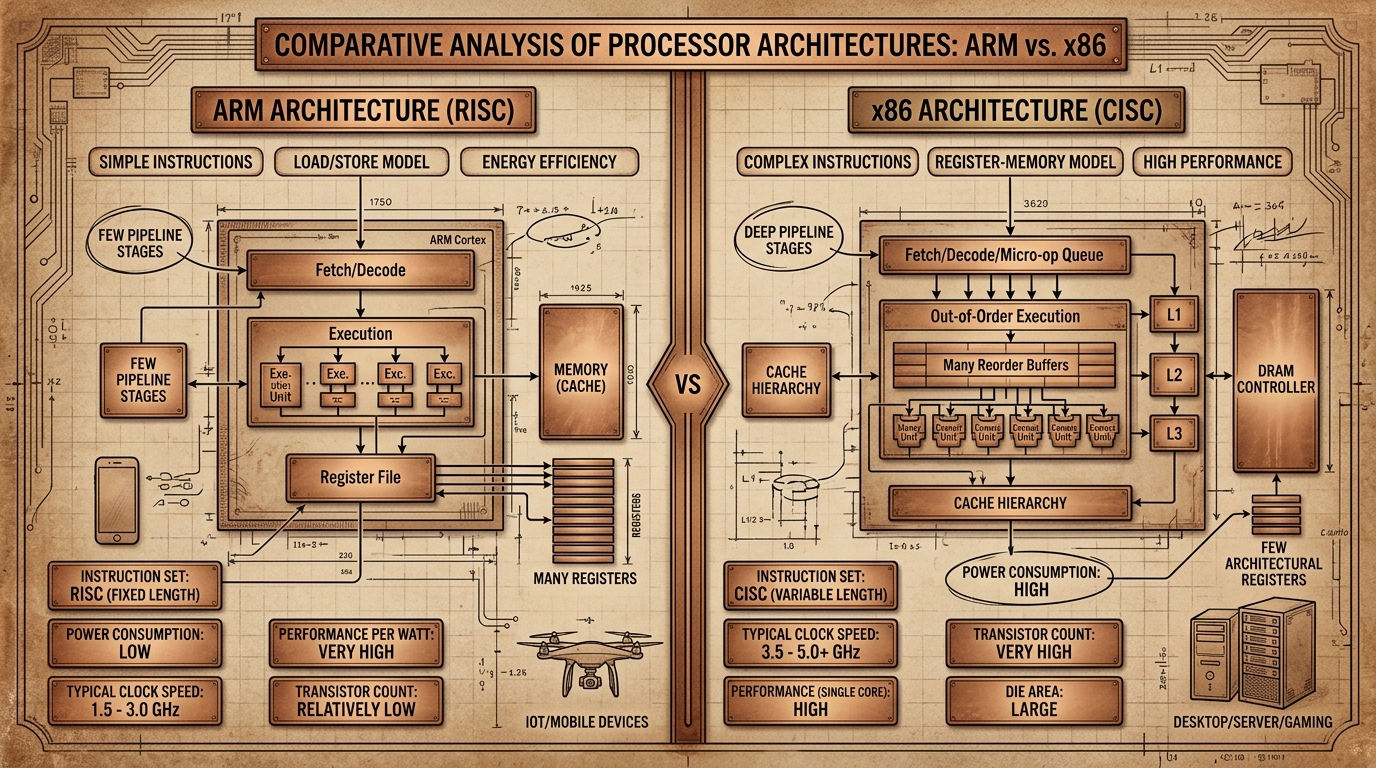
The data center processor landscape is undergoing its most radical transformation in decades, driven by the relentless pursuit of energy efficiency and workload optimization. For years, Intel and AMD maintained a duopoly over server infrastructure utilizing the x86 architecture. Now, the reduced instruction set computing model pioneered by ARM has breached the data center walls. This shift is not merely a theoretical exercise in chip design; it represents a fundamental reallocation of billions of dollars in global capital expenditure. The efficiency gains offered by ARM architecture are proving irresistible to cloud providers grappling with immense power constraints and thermal management challenges.
Hyperscalers are leading this revolution by designing and deploying their own custom silicon. Amazon Web Services aggressively iterates on its Graviton processors, offering superior price-to-performance ratios compared to legacy alternatives. This vertical integration allows cloud giants to bypass traditional merchant silicon vendors entirely, capturing higher margins and offering specialized instances to their clients. The success of AWS Graviton has forced competitors like Microsoft Azure and Google Cloud to accelerate their own proprietary chip development programs. Quantitative analysts track instance deployment data closely, as the availability of custom silicon directly correlates with cloud profit margins .
Independent silicon designers like Ampere Computing are providing powerful ARM-based alternatives to enterprises managing on-premises infrastructure or multi-cloud environments. The Ampere Altra Max targets the exact workloads where x86 struggles, providing massive core counts optimized for cloud-native applications. This democratization of ARM technology ensures that the architectural shift is not restricted solely to the major hyperscalers. Algorithmic trading models are highly sensitive to server shipment data, utilizing alternative metrics to gauge the velocity of ARM adoption across the broader enterprise market.
Quantifying Total Cost of Ownership
The primary catalyst for the ARM transition is the profound advantage in total cost of ownership for specific computational workloads. Traditional x86 processors excel at raw, single-thread performance, but modern cloud applications prioritize scaling out across hundreds of efficient cores. ARM processors deliver significantly higher performance per watt, drastically reducing the energy costs associated with running massive server farms. This reduction in power consumption simultaneously lowers the thermal output, allowing data center operators to deploy denser racks without requiring expensive cooling upgrades.
Evaluating this shift requires granular analysis of workload-specific benchmarks. For database operations, web serving, and in-memory caching, ARM instances consistently outperform their x86 counterparts on a cost-adjusted basis. Software developers are rapidly recompiling their codebases to support ARM architecture, eliminating the historical software compatibility moat that protected legacy manufacturers. Trading desks employ automated scrapers to monitor software repository commits, identifying real-time trends in architectural support among open-source developers.
The economic implications for traditional semiconductor manufacturers are severe. As hyperscalers dedicate larger percentages of their capital expenditure to custom silicon, the total addressable market for merchant server chips shrinks. Intel and AMD must aggressively discount their hardware to maintain market share, applying significant downward pressure on their gross margins. Quantitative strategies exploit these margin contractions, executing complex pairs trades that short legacy manufacturers while taking long positions in foundries and intellectual property licensors facilitating the ARM ecosystem.
Nvidia Grace and the AI Infrastructure Play
The battle for data center supremacy extends beyond general-purpose computing into the highly lucrative artificial intelligence sector. Nvidia has introduced the Grace CPU, an ARM-based processor designed specifically to complement its dominant graphic processing units. By coupling their GPUs with proprietary ARM CPUs, Nvidia creates highly efficient, tightly integrated systems optimized for training massive language models. This architectural synergy bypasses the traditional x86 bottlenecks, ensuring that data flows seamlessly between the processor and the accelerator.
This strategic move places immense pressure on Intel and AMD, who rely on their CPU dominance to anchor data center sales. If AI clusters shift entirely toward unified ARM-GPU architectures, legacy vendors risk being locked out of the highest-growth segment of the technology market. The success of the Nvidia Grace architecture validates the ARM model for high-performance computing, fundamentally changing the enterprise hardware narrative. Algorithmic models heavily weight corporate earnings calls for mentions of advanced server architectures, correlating narrative shifts with forward stock multiples.
The semiconductor supply chain represents a critical vulnerability in this technological transition. The reliance on advanced foundries like TSMC to manufacture these complex ARM chips creates geopolitical risks that must be quantified. Hedge funds utilize satellite data and shipping manifests to monitor foundry utilization rates, predicting output volumes for key processor lines. Any disruption in semiconductor manufacturing capabilities would instantly alter the competitive dynamics between ARM challengers and x86 incumbents.
Adapting Valuation Models for Semiconductor Stocks
The benchmark war between ARM and x86 necessitates a complete overhaul of traditional semiconductor valuation models. Analysts can no longer rely on simplistic metrics like server unit shipments; they must evaluate the specific architectural mix and the margin profile of custom silicon deployments. Companies holding critical intellectual property rights in the ARM ecosystem, such as ARM Holdings itself, command massive valuation premiums due to their insulated revenue streams. Quantitative funds construct intricate supply chain models to capture the diverse revenue flows generated by licensing, manufacturing, and deploying these advanced processors.
The enterprise software ecosystem plays a massive role in dictating the pace of adoption. Major enterprise resource planning and database vendors must fully optimize their platforms for ARM to secure broad corporate acceptance. The announcement of native ARM support by a major software vendor triggers immediate re-evaluations of hardware procurement forecasts. Trading algorithms parse technical press releases and developer conference keynotes in real time, executing trades based on the evolving software compatibility landscape.
Ultimately, the data center benchmark war represents a permanent fragmentation of the processor market. x86 architectures will retain their dominance in specialized, high-performance tasks requiring complex instruction sets. However, the vast majority of scale-out cloud workloads will inevitably transition to highly efficient ARM platforms. Investors who accurately model this bifurcated market will capture significant alpha, while those relying on historical hardware paradigms face substantial risk in their semiconductor portfolios.
Disclaimer: This article is for informational purposes only and does not constitute financial, investment, or legal advice. The views expressed are those of the author and do not necessarily reflect the official policy or position of AlgoFinance. Consult a qualified professional before making any financial decisions.